Phase-Locked Loops: Design, Simulation, and Applications, Fifth Edition

Dynamic analysis of a control system is normally performed by means of its transfer function H( s). H( s) relates the input and output signals of the system; in conventional electrical networks the input and the output are represented by voltage signals u 1( t) and u 2( t), respectively, so H( s) is given by
| (2.1) | |
where U 1( s) and U 2( s) are the Laplace transforms of u 1( t) and u 2( t), respectively, and s is the Laplace operator. In the case of the PLL, the input and output signals are phase signals, however, which are less familiar to many electronic engineers.
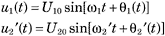
To see what phase signals really are, we assume for the moment that both input and output signals of the PLL (Fig. 2.1) are sine waves:
| (2.2) | |
The information carried by these signals is neither the amplitude ( U 10 or U 20, respectively) nor the frequency ( ? 1 or ?2 ?, respectively) but the phases ? 1( t) and ? 2 ?( t). ( Note: because we used the symbol ? 2 ? for the radian frequency at the output of the down-scaler (Fig. 2.1), we use the symbol ? 2 ? for the phase of signal u 2 ? and not ? 2; the...