Phase-Locked Loops: Design, Simulation, and Applications, Fifth Edition

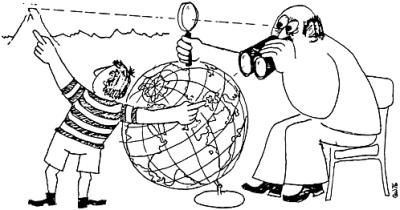
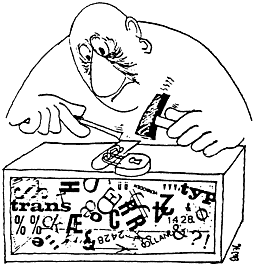
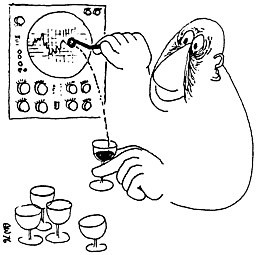
Trying to solve electronic problems without using the Laplace transform is like traveling through a foreign country with a globe instead of a map (Fig. B.1). An engineer who tries to find the transient response of an electric network to an impulse function by solving differential equations, for example, certainly is working with inadequate tools (see Fig. B.2). The engineer familiar with the techniques of the Laplace transform may find a solution very quickly, as shown in Fig. B.3.
A map images a three-dimensional object to a plane. Every spatial point of the three-dimensional object is represented by a unique point in the plane of the map. Things are similar, though different, in the case of the Laplace transform. Here a function in the time domain (such as an electric signal) is transformed to another function in the complex frequency domain. The trouble with the Laplace transform starts right here: even an electronic hobbyist can imagine what the frequency spectrum of an electric signal is, but what is complex frequency?
One need not be a cow...