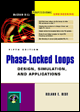
Phase-Locked Loops: Design, Simulation, and Applications, Fifth Edition
PLL frequency synthesizers play an ever-increasing role in the field of communications. Originally, the frequency synthesizer was a system creating a set of frequencies that were an integer multiple of a mostly fixed reference frequency. Such synthesizers (referred to as integer-N frequency synthesizers) are found in every FM radio receiver, TV receiver, and the like. Later the fractional N synthesizer was developed. In contrast to the integer- N frequency synthesizer, this novel device is able to create frequencies that are N.f times a reference frequency, where N is the integer part and f the fractional part of an arbitrary number. Whereas fractional- N synthesizers have been considered rather exotic in the past, they suddenly have gained increased interest, mainly in spread-spectrum applications.
Conventional communications used one single carrier whose frequency was fixed. Radio and TV transmitters are examples for this category. In military communications it turned out that such constant-carrier-frequency links could easily be corrupted by "jammers."20 This led to the development of "frequency hopping." In frequency hopping applications, the single carrier is replaced by a large set of carrier frequencies. This set consists of a number N of carrier frequencies that are switched in a pseudo-random manner. This means that the transmitter repeatedly jumps through these N carrier frequencies. The receiver, which must know the carrier frequency sequence of course, has to track the carrier frequency at any time. Each individual carrier frequency is called a "chip" in the frequency hopping...