Phase-Locked Loops: Design, Simulation, and Applications, Fifth Edition

2.9: Design Procedure for Mixed-Signal PLLs

2.9 Design Procedure for Mixed-Signal PLLs

The mixed-signal PLL can be built in many variants, and the spectrum of applications is very broad as well. There are PLL applications in communications where the system is used to extract the clock from a (possibly noisy) information signal. In such an application, noise suppression is of importance. An entirely different application of the PLL is frequency synthesis. Here, reference noise is not of concern, but the synthesizer should be able to switch rapidly from one frequency to another; hence pull-in time is the most relevant parameter.

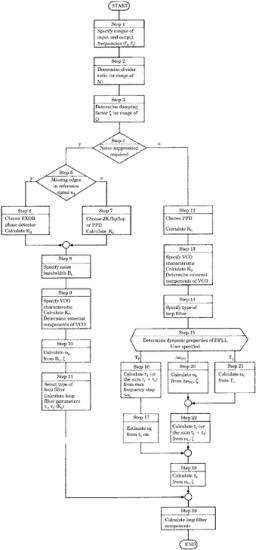
For these reasons it appears difficult to give a design procedure that yields an optimum solution for every PLL system. In this section we present a PLL design prcedure that is based on a flowchart, Fig. 2.49. To help in computing the relevant entities in the PLL design, the often used formulas for the PLL key parameters are listed in four tables, Tables 2.1 to 2.4. Table 2.1 shows the equations for hold range, lock range, etc., for a PLL using a type 1 phase detector. Table 2.2 presents the same information, but for an EXOR phase detector, etc.


Figure 2.49: Flowchart of the mixed-signal PLL design procedure.

The step-by-step design procedure of Fig. 2.49 should not be considered as a universal tool for the thousand and one uses of the PLL but rather as a series of design hints. Moreover, in many cases the design of a PLL will be an iterative process. We...

UNLIMITED FREE
ACCESS
TO THE WORLD'S BEST IDEAS

SUBMIT
Already a GlobalSpec user? Log in.

This is embarrasing...

An error occurred while processing the form. Please try again in a few minutes.

Customize Your GlobalSpec Experience

Category: IC Phase-locked Loops (PLL)
Finish!
Privacy Policy

This is embarrasing...

An error occurred while processing the form. Please try again in a few minutes.