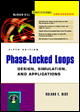
Phase-Locked Loops: Design, Simulation, and Applications, Fifth Edition
Chapter 4: Higher-Order Loops

4.1 Motivation for Higher-Order Loops

In Chaps. 2 and 3 we considered mainly second-order PLLs. These loops used first-order loop filters as shown in Fig. 2.16. As can be seen from the Bode diagrams of the loop filter transfer functions in Fig. 2.17 the gain rolls off at ?20dB/dec at higher frequencies but asymptotically approaches a nonzero value for radian frequencies higher than 1/ ? 2, where ? 2 is the time constant in the numerator of the filter transfer function (see Eqs. 2.26 to 2.28). In the discussion of spectral purity of PLL frequency synthesizers, we recognized that reference frequency feedthrough becomes a problem. Spurious sidebands can be intolerable if the loop filter does not sufficiently attenuate ac components at the reference frequency (plus harmonics) that are created by the phase detector. To reduce reference frequency feedthrough we must use higher-order loop filters, i.e., loop filters of order 2 or higher.

With higher-order loop filters, loop stability becomes an issue. Getting stable operation with a second-order PLL was easy because the open-loop transfer function had two poles and one zero. A pole creates a phase shift of ?90 at higher frequencies, and a zero creates a phase shift of +90 . When the poles and the zeros are properly located the overall phase shift never comes close to ?180 ; hence the loop stays stable. This goal was easily met by choosing time constant ? 2 of the loop filter such that a reasonable damping factor ?

UNLIMITED FREE
ACCESS
TO THE WORLD'S BEST IDEAS

SUBMIT
Already a GlobalSpec user? Log in.

This is embarrasing...

An error occurred while processing the form. Please try again in a few minutes.

Customize Your GlobalSpec Experience

Category: IC Phase-locked Loops (PLL)
Finish!
Privacy Policy

This is embarrasing...

An error occurred while processing the form. Please try again in a few minutes.