Practical Filters and Couplers: A Collection from Applied Microwave & Wireless
With contributions from more than 20 experts, these articles will show you how to use the latest design and testing techniques for filters, couplers and baluns.
 TABLE OF CONTENTS
 Here is a practical review of a common band-pass filter topology one of the simplest types to implement in production
By GlenVar Rosenbaum
From APPLIED MICROWAVE & WIRELESS, VOL. 10, NO. 8, OCTOBER 1998
One of the more practical filters available for RF narrow-band applications is the capacitive-coupled filter. Particular variations of the basic configuration can also be quite useful. For example, some manipulation with impedance matching can provide better real-world component values. Also, higher or lower out-of-band roll-off can be implemented in the design. Another special feature is that transmission notches can be inserted for particularly steep roll-off. These advantages make the capacitive-coupled filter, along with the proposed variations, very useful in a number of applications.
The concepts presented in this article will show the basic generation of the filter and then will progress to variations that add more capability. This will be done with a combination of hand analysis and C programming for synthesis of the filter. Analysis and final optimization will be done with Ansoft s Serenade software package (formerly Compact), a powerful Integrated Development Environment (IDE) tool.
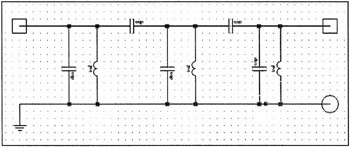
Figure 1 shows the general form of a capacitive-coupled filter. The C++ design program determines component values for the configuration shown in Figure 2. This configuration is generally preferred over others, such as the one illustrated in Figure 3(c), because it is heavy in capacitors and light in inductors. Generally, radiation concerns, cost and convenience side with capacitors more than inductors in production.