Practical Filters and Couplers: A Collection from Applied Microwave & Wireless
With contributions from more than 20 experts, these articles will show you how to use the latest design and testing techniques for filters, couplers and baluns.
 TABLE OF CONTENTS
 By Richard M.Kurzrok, PE
From APPLIED MICROWAVE & WIRELESS, VOL. 11, No. 6, JUNE 1999
At microwave frequencies from about 8 GHz to 18 GHz, waveguide band-pass filters are often needed to provide required selectivity. In communications equipment, these filters are often connected to various adjacent coaxial components.
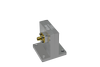
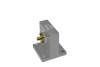
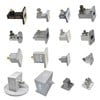
Conventional rectangular waveguide filters are normally supplied with waveguide flanges, as shown in Figure 1. To use these filters in a coaxial system, two external coax to waveguide adapters will be needed. By designing the filter for coaxial interfaces using SMA connectors (as shown in Figure 2), appreciable savings in cost and size can be obtained.
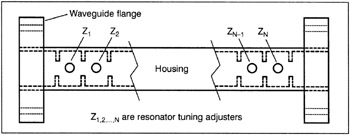
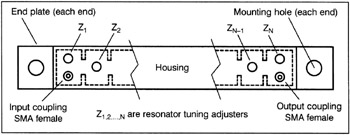
For small and moderate bandwidths, waveguide band-pass filter input and output couplings can be realized by using probe couplings from coaxial lines rather than waveguide input and output couplings with inductive irises, posts, or vanes. As illustrated in Figure 2, the waveguide filter housing no longer uses waveguide flanges. Instead, milled block quarterinch thick brass end plates are silver-soldered to the ends of the waveguide housing. Vertical number 8 32 clearance holes (or another size, as required) are drilled in the end plates to provide convenient mounting holes for the filter. The tuning screws for the first and last resonators are offset on the E-Plane wall of the waveguide to make room for offset input and output probe assemblies.