Practical Filters and Couplers: A Collection from Applied Microwave & Wireless
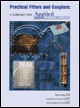
With contributions from more than 20 experts, these articles will show you how to use the latest design and testing techniques for filters, couplers and baluns.
 TABLE OF CONTENTS
 Introducing an additional attenuation pole in output coupling contributes to isolation in a 170 MHz radio diplexer.
By Ralph Levy and Konrad J.Andersen
From APPLIED MICROWAVE & WIRELESS, VOL. 4, NO. 2, SUMMER 1992
Filters and multiplexers used in the high- frequency band (HF), as well as those at the low microwave frequencies, are often very large due to low insertion loss requirements for closely spaced narrow-band channels. Size reduction over cavity filters may be considered using helical resonators [1], but frequently these will not suffice if normal Chebyshev filters are used, since the degree of a filter is often such that the loss would be excessive. Finite attenuation poles must be included to give more optimum lower loss structures, but there appears to have been no work on helical resonator elliptic function type filters, that is, lumped-element elliptic filters in which the resonator Q is much higher than the customary maximum Q of about 400.
This article introduces the concept of helical filters and multiplexers having quasi elliptic function characteristics and also demonstrates the advantage of using extra rejection poles realized in the input and output coupling networks. The techniques are illustrated by describing a diplexer consisting of two narrow band closely spaced channels in the 164 to 175 MHz band having relatively low insertion loss, small size and light weight. The diplexer measures 2.2 6 6 inches, and replaced a compline diplexer of dimensions 6 10 18 inches, more than 13 times the size of this helical diplexer.