Practical Filters and Couplers: A Collection from Applied Microwave & Wireless
With contributions from more than 20 experts, these articles will show you how to use the latest design and testing techniques for filters, couplers and baluns.
 TABLE OF CONTENTS
 The authors describe a method for dealing with the problem of out-of-band mismatch among multiple filters
By Carlos Cesar Rocha, A.J.M.Soares and H.Abdalla Jr.
From APPLIED MICROWAVE & WIRELESS, VOL. 10, NO. 1, JANUARY/FEBRUARY 1998
This article describes the design procedure for a multiplexer using complementary filters. The suggested technique allows the design of matched structures over a large range of frequencies. The required conditions at the network that may be realizable with complementary filters are shown. The design procedure is developed for band-pass and bandstop complementary filters connected at a common junction for narrow band applications. A stripline structure was used to realize one diplexer. Experimental and theoretical results agree.
Multiplexers are devices that split a wide frequency band into a number of signal bands of different ranges. The separation of the desired frequency bands can be made using band-pass filters combined at a common input (Figure 1).
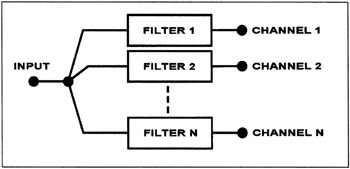
The main problem with this kind of topology is that the filters are reflective devices whose performance is specified by good impedance matching between source and load in the pass band, and a strong mismatch outside. If several of these filters are simply connected together, undesirable mutual interaction effects will appear, because the input impedance of the individual filters is not predictable outside their own pass bands. This causes a drastic variation in the impedance presented to the external circuitry at each filter in its respective band. This...