Industrial Electronics for Engineers, Chemists, and Technicians: With Optional Lab Experiments

Many (probably most) electrical circuits have one side of the power supply attached to the "ground."
One reason for doing this is that the device often includes some kind of a large conductor such as a metal cabinet, and the designer might as well make use of it to be one of the two necessary conductors, just as a convenience. If direct current is being used, the "ground" is often made the negative side, although it is not always done this way. If long distance alternating current systems are being used, such as the electric power in your house, the surface of the earth itself can be utilized for one side of the circuit. This will be a low resistance path, on account of its being extremely wide and thick.
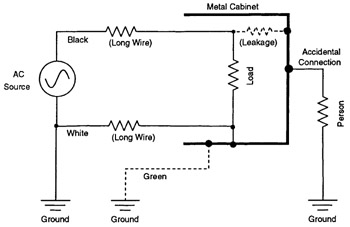
A second reason for using the ground is for safety. The interior wiring will be carrying various voltages, insulated from the cabinet, as shown by Fig. 6.1 on the following page. (The reader should note the standard symbols for the grounds and for the source of alternating current, such as a 120 volt ac wall socket.) Imagine that the dashed-line "green" wire and the "leakage" are not present, and a lot of current is flowing through the white wire. Then the voltage drop across the white wire's resistance might make a considerable potential appear on the cabinet.
A person operating the equipment...