Industrial Electronics for Engineers, Chemists, and Technicians: With Optional Lab Experiments

While most metals like copper and silver are electrical conductors, most oxides like quartz and sapphire are insulators. "Semiconductors" have conductivities that are in between, examples being a few metals like selenium and a few compounds like copper oxide. In conductive metals, the electric current consists of moving electrons, but in semiconductors it can be either negatively charged electrons, or something else: positively charged "holes."
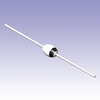
If a semiconductor having mostly electrons is put in contact with a different kind having mostly holes, the electricity can be allowed to go in one direction but prevented from going in the opposite direction. Thus ac can be converted to dc, and this is called "rectification" (left over from the days when ac was considered disadvantageous, and converting it to dc was making it "right" again). The device that is made this way has two wires attached to it and is called a "diode" ("di-" meaning two in Latin, and "-ode" standing for "electrode").
If three semiconductors are put together in just the right way, a small current through one can control a large current through the others ("amplification" of the current). The resulting device is called a "transistor," (short for "transfer resistor").
The reader probably remembers from chemistry courses that the electrons orbiting around in the outer shells of an atom can only have certain energies, but not others. Nature allows these "energy levels" to be whole numbers of the lowest energy units, such...