Industrial Electronics for Engineers, Chemists, and Technicians: With Optional Lab Experiments

Chapter 18: FETs and Tubes

VACUUM TUBES

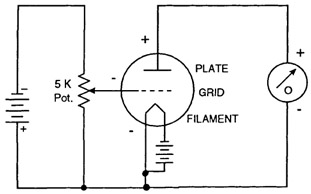
As mentioned earlier in this book, modern electronics would not be practical without "amplification" (see pages 165 and 166 if necessary), because this allows a large number of operations to be performed in series, without any total loss of signal strength from various resistances. The first practical amplifying device was the triode vacuum tube, invented by Lee de Forest in 1906. The symbol for a triode is in the middle of Fig. 18.1, and it is a concise description of what is actually inside the tube. (An ohmmeter provides "plate voltage" in this diagram.)


Figure 18.1: Triode vacuum tube amplifier. (Compare to page 168.)

As most readers know, the vacuum tube (sometimes called an "electron tube" or just a "tube") is a glass cylinder, closed at both ends, with some wires going through the glass, with "glass-to-metal seals." The air has been pumped out, leaving a good vacuum inside. A tungsten filament is heated to about 750 C, where it emits red light (in comparison to an incandescent lightbulb filament, heated to about 1500 C and emitting white light).

Not only is red light given off, but electrons are also emitted, and these can be collected by a metal plate that is about a centimeter away and has a positive charge. Electrons can not go in the opposite direction (emitted from a cold plate), so a diode tube can act as a rectifier, converting ac to dc. This phenomenon was reported by Thomas A. Edison in 1883, but like a...

UNLIMITED FREE
ACCESS
TO THE WORLD'S BEST IDEAS

SUBMIT
Already a GlobalSpec user? Log in.

This is embarrasing...

An error occurred while processing the form. Please try again in a few minutes.

Customize Your GlobalSpec Experience

Category: Vacuum Tubes
Finish!
Privacy Policy

This is embarrasing...

An error occurred while processing the form. Please try again in a few minutes.