Industrial Electronics for Engineers, Chemists, and Technicians: With Optional Lab Experiments

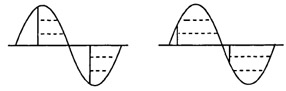
It was pointed out that high currents can be controlled by reactance without losing energy as heat, back in the chapters on capacitors (page 102) and inductors (page 115). Another way to control high current is to quickly turn the current all the way on and then all the way off. This can be done as shown in Fig. 21.1, by using some kind of "gating" switch to stay turned off, and then suddenly turn on the current, but only when the voltage reaches a certain controllable percentage of its eventual peak value. More average current can be allowed to go through if the switch is turned on earlier, as in the right-hand diagram. Either way, at the right or left of the figure, no heat is lost ("dissipated") inside the switch itself, if it is working in an ideal all-the-way-on and all-the-way-off manner. By comparison, a rheostat would lose a great deal of power (maybe most of it) as heat.
One type of semiconductor device, a "trigger diode," can be used to set the turn-on voltage, but it can not handle the high currents that would be useful for large heating elements or motors. Another device, an "SCR," can quickly gate the high currents, but it is not easily adjusted to turn on at certain desired voltage levels. Therefore both devices are attached together, and this combination is being used a lot for...