Industrial Electronics for Engineers, Chemists, and Technicians: With Optional Lab Experiments

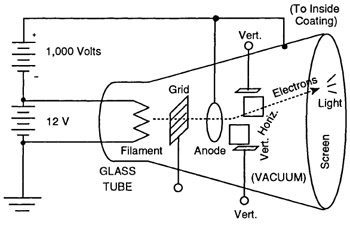
The most important part of an oscilloscope is a large, cone-shaped glass tube with a vacuum inside. It operates the way the old "vacuum tube" radios worked, before the invention of transistors. That is, there is a tungsten wire "filament" at the small end, which is heated by a low voltage but high current source, which could be a battery. Electrons tend to fly off this hot wire, almost like vapor from a boiling liquid. The battery and filament assembly is the left-hand part of Fig. 8.1, on the next page.
Since the electrons are negatively charged, they get strongly attracted to a wire hoop which has a high positive charge on it, from another power source, shown here as thousand-volt battery. (This would work, but in a regular oscilloscope, 120 volt ac from a wall socket is changed into thousand-volt dc by methods that will be explained later in the course.) Some of the electrons get collected by the "anode" hoop and returned to the battery, but many are going so fast that their momentum tends to keep them going to the right, rather than changing direction quickly enough to get caught by the hoop, so they fly through the large hole in the middle. Since the beam of electrons is coming from the negatively charged filament (the "cathode" of the 1,000V circuit), this beam is called the "cathode ray." The whole tube is sometimes called a "cathode ray tube," or...