Industrial Electronics for Engineers, Chemists, and Technicians: With Optional Lab Experiments

Chapter 4: Series Resistances, Part I: Bad Output Voltages

TWO RESISTORS

Just as the news media (TV, newspapers, and magazines) tend to concentrate on accidents and crimes, this book tends to concentrate on common industrial problems, in the hope that the reader will not become bored. Thus the word "Bad" in the title of this chapter. However, there is good news, too, because these problems can be solved. The solutions are often quite easy, provided there is some depth of understanding. Once again, several different analogies involving water behavior will be used as aids in explaining electrical behavior. In a few cases the result is not what one might ordinarily expect, without considerable analysis.

Water Analog

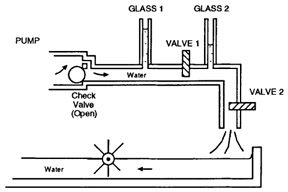
If a recirculating water system is operated at the same pump pressure as was used in the previous chapter, but this time there are two of those valves, one after another, then each one of the valves contributes some resistance to the water flow. Therefore less water would be expected to flow. A pump and valve system of this kind is illustrated in Fig. 4.1 on the next page. If each of the two valves is open to the same degree as it was in the previous chapter, it is intuitively apparent to the reader that the total water flow rate will now be half that of the previous chapter. The two valves are said to be " in series."


Figure 4.1: A water pump analog of two resistors in series.

The diagram shows the two valves being equally

UNLIMITED FREE
ACCESS
TO THE WORLD'S BEST IDEAS

SUBMIT
Already a GlobalSpec user? Log in.

This is embarrasing...

An error occurred while processing the form. Please try again in a few minutes.

Customize Your GlobalSpec Experience

Category: News Sites
Finish!
Privacy Policy

This is embarrasing...

An error occurred while processing the form. Please try again in a few minutes.