Industrial Electronics for Engineers, Chemists, and Technicians: With Optional Lab Experiments

Chapter 9: Capacitors

WATER ANALOG

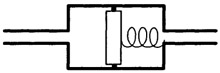
Imagine a system of water pipes as shown in Fig. 9.1, with a wide cylinder, and a movable piston inside that. A spring tends to keep the piston near the middle. A rubber O-ring around it (shown in cross section as two black dots) makes a fairly good seal, but the piston can still slide to the right or left if water pushes it.


Figure 9.1: A water analog of a capacitor.

Water coming into the cylinder will push the piston until the restoring force of the spring becomes equal to the force from the water, and then all motion will stop. Therefore water that moves toward the right, as shown in the diagram, will only be able to move for a short time. The larger the size (the volume) of the cylinder, the more mass of water will be stored in it before it stops, with constant pressure driving the system. Also, if the pressure is changed, but the size is held constant, then the more water pressure, the more mass of water will be stored in the piston/spring system before it stops "charging up." (This would be similar to pumping air into a tire the more volume and/or the more pressure, the more total mass of air will be put in, until the inside pressure becomes equal to the pumping pressure, and then it will stop.) Therefore, we could write an equation where

(9.1)

It is important to realize that water...

UNLIMITED FREE
ACCESS
TO THE WORLD'S BEST IDEAS

SUBMIT
Already a GlobalSpec user? Log in.

This is embarrasing...

An error occurred while processing the form. Please try again in a few minutes.

Customize Your GlobalSpec Experience

Category: Air Cylinders
Finish!
Privacy Policy

This is embarrasing...

An error occurred while processing the form. Please try again in a few minutes.