Industrial Electronics for Engineers, Chemists, and Technicians: With Optional Lab Experiments

Chapter 12: Relays

WHAT THEY ARE

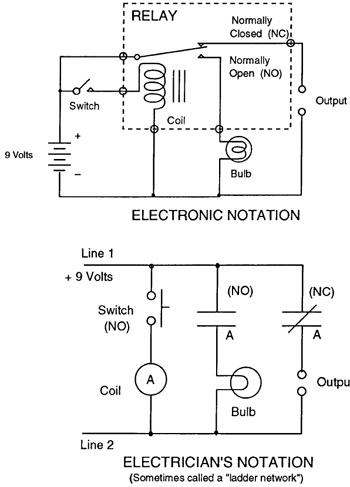
The ordinary type of relay is an electromagnet that operates a switch. Many kinds of switch can be used, including the "SPDT" (see Index to find explanation in an earlier chapter), which is shown in Fig. 12.1. In this course, the inexpensive relay that is recommended is a "DPDT," but its full capabilities will not be exploited, and it will just be operated in the single pole mode.


Figure 12.1: A basic relay circuit, shown with both types of symbols.

Relays are analogous to water faucets, because both allow small amounts of energy to control very large amounts of energy. Relays are in use all around us, for everyday applications such as controlling air conditioners and heating systems, and for limiting electric currents by means of circuit breakers. For many decades, special forms of relays such as "stepping switches" and "crossbar systems" were the main devices used to automatically switch telephone signals, thus selecting which phone was to be connected to another. A disadvantage of the relay, however, is that it can only be all the way "on" or all the way "off," and not in between.

In the circuit of Fig. 12.1, the 15 ma at 10 volts in the coil could be used to control as much as 15 amperes at 100 volts in the contacts, a power increase of 10,000 times. The relay itself includes the parts within the dashed-line rectangle. Small open circles on that line are the "terminals" of the relay. "Electronic...

UNLIMITED FREE
ACCESS
TO THE WORLD'S BEST IDEAS

SUBMIT
Already a GlobalSpec user? Log in.

This is embarrasing...

An error occurred while processing the form. Please try again in a few minutes.

Customize Your GlobalSpec Experience

Category: Solid State Relays
Finish!
Privacy Policy

This is embarrasing...

An error occurred while processing the form. Please try again in a few minutes.