Industrial Electronics for Engineers, Chemists, and Technicians: With Optional Lab Experiments

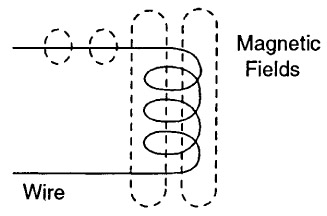
The reader probably remembers from previous courses in general science that an electric current going through a wire will produce magnetism. The "magnetic field" is around the wire, somewhat like an invisible tube. This is shown diagrammatically by the two circles at the upper left of Fig. 10.1. When the wire is coiled, as at the right-hand side of the figure, the fields line up to make a "donut" or "toroid" of magnetic fields, much stronger than the fields around the single wire portions.
If an iron rod (not shown in the diagram) is poked vertically down through the coil, the fields can go through that iron much easier than through air or vacuum. The ease of producing a strong field is called "permeability," and it is somewhat similar to the "dielectric constant" described on page 92. Iron is easily "polarized" magnetically, because it has many "unpaired" electrons that are spinning. An electron spinning generates a small magnetic field of its own. The spins can be lined up in the same direction, if they are put in a field such as the one from the wire. In some ways this is similar to the charges lining up inside the ceramic "dielectric" shown on page 91, thus raising the capacitance.
Of course, an iron core plus a coil of wire can be an "electromagnet." When the current is first turned on, the field suddenly expands, from zero to whatever...