
Chemical Vapor Deposition (CVD) Thin Film Equipment
Description
Chemical Vapor Deposition (CVD) Thin Film Equipment is designed to deposit thin films onto substrates through a chemical reaction. This equipment introduces vaporized precursors into a reactor, where they undergo a chemical transformation to form a solid film on the substrate surface. The process is versatile, allowing for the deposition of various materials, including metals, semiconductors, and ceramics, with high purity and uniformity.
Working Principle
CVD operates by introducing vaporized precursor gases into a reactor chamber, where they adsorb onto a heated substrate. The elevated temperature facilitates a chemical reaction, either through thermal decomposition or interaction with other gases, resulting in the formation of a solid film on the substrate. This process is advantageous due to its ability to produce films with precise thickness and composition, making it highly useful for applications requiring high-quality coatings. The process's flexibility allows for the creation of amorphous, polycrystalline, or single crystalline films, depending on the specific conditions used.
Applications
CVD is widely used in the semiconductor industry for creating integrated circuits and solar cells. It is also employed to coat metals such as molybdenum, tantalum, titanium, nickel, and tungsten. Additionally, CVD is instrumental in producing synthetic diamonds, which are used in various industrial applications due to their hardness and thermal conductivity.
Advantages over other Thin Film Equipment
CVD offers several advantages over other thin film deposition methods. It provides excellent conformability, ensuring uniform film thickness even on complex-shaped substrates. The process can deposit a wide range of materials with high purity and at relatively high deposition rates. Unlike some other methods, CVD requires less vacuum pressure, which can simplify the equipment and reduce costs.
Limitations
One of the primary limitations of CVD is the requirement for precursors to be volatile at near-room temperature, which can limit the choice of materials. The process also involves hazardous byproducts, necessitating careful handling and disposal. Additionally, the high temperatures required for deposition can induce mechanical stress if the substrate and film materials have different thermal expansion coefficients.
Considerations
When considering CVD equipment, initial costs can be significant due to the complexity of the reactors and the need for precise control systems. Operating expenses may also be high, given the energy requirements for maintaining elevated temperatures and handling hazardous materials. Durability and accuracy of the equipment are crucial, as they directly impact the quality of the deposited films. Maintenance and replacement costs should be factored in, as the equipment may require regular servicing to ensure optimal performance and safety.
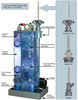
from EBARA Technologies, Inc.
Gas Inlet Devices. Patent gas inlet devices minimize rate of restriction and automatic gas inlet plunger removes restrictions without process interruptions. Second Scrubbing Chamber. Five fine spray, high velocity nozzles ensures effective removal of impurities. First Scrubbing Chamber. Coarse... [See More]
- Process: Chemical Vapor Deposition
- Applications: Semiconductors
- Type: Free Standing System; Cluster Tool
- Materials Processed: Tungsten; Metal; Silicon; Polymer; Nitrides