
Linear Control Level Controllers
Last Updated: April 1, 2025
Description
Linear Control Level Controllers are devices designed to manage and regulate the level of a substance within a container or system. They achieve this by adjusting the input or output flow to maintain a desired level, ensuring that the system operates within specified parameters.
Working Principle
Linear Control Level Controllers operate by matching a variable input signal with a corresponding variable control signal. This is achieved through the use of proportional, integral, and derivative (PID) control methods, which require real-time system feedback. The PID control monitors the error between a desired level and the actual level, adjusting the control signal accordingly. This closed-loop operation helps maintain stability and accuracy in the system, making these controllers particularly useful in processes where precise level control is critical.
Applications
Linear Control Level Controllers are widely used in various industries. For example, in the chemical industry, they are employed to maintain the correct level of reactants in a reactor to ensure optimal reaction conditions. In the food and beverage industry, they help manage the levels of liquids in storage tanks to prevent overflow or underfill, ensuring consistent product quality.
Advantages over other Level Controllers
One of the primary advantages of Linear Control Level Controllers is their ability to provide precise control through PID methods, which can dampen system response, correct offsets, and prevent overshoot or undershoot. This makes them more suitable for applications requiring high accuracy and stability compared to simpler on-off or bang-bang controllers.
Limitations
Despite their advantages, Linear Control Level Controllers can be complex to set up and require careful tuning to achieve optimal performance. They may also be less effective in highly non-linear processes where non-linear control strategies might be more appropriate.
Considerations
When considering Linear Control Level Controllers, it is important to evaluate the initial costs, which can be higher due to the complexity of the system. Operating expenses may also be elevated due to the need for regular maintenance and tuning to ensure accuracy and reliability. However, their durability and precision can offset these costs in applications where precise level control is essential. Replacement and maintenance costs should also be factored into the decision-making process, as these can vary depending on the specific application and environmental conditions.
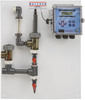
from Iwaki America and Walchem, IWAKI America Inc
Walchem's WDIS Series controller will reliably and economically control your water treatment disinfection process.The controller includes four standard sensor input options (free chlorine/bromine, chlorine dioxide, ozone and peracetic acid) or can be configured to use a variety of other types of... [See More]
- Control: Limit; Linear; PID; Nonlinear
- Features: Multi-Function; Datalogger
- Controller Type: Laboratory
- Form Factor: Chassis

from Florite International, Inc.
The 900 Series is an economic one loop microcomputer-based instrument incorporating user selectable digital and analog inputs, as well as analog and relay outputs. Other 900 Series features include .005% high accuracy PID, batch, and dose control functions. Additionally, the 900 Series encompasses... [See More]
- Control: Limit; Linear; Feedforward; PID
- Features: PLC; Multi-Function; Datalogger; Is a Chart Recorder; Rate Indication/ Control; Totalizing (Length or Roll Diameter) Indication/ Control
- Controller Type: Batch; Flow; Laboratory; Pressure
- Form Factor: Board (optional feature); Chassis; Rack; Stand-Alone; Wall Mount