
Resistive / Potentiometer Input Level Controllers
Last Updated: April 1, 2025
Description
Resistive/Potentiometer Input Level Controllers are devices used to measure and control the level of a substance, typically a liquid, within a container. They achieve this by utilizing a potentiometer, which is a type of variable resistor, to detect changes in the level of the substance and adjust the output signal accordingly.
Working Principle
The working principle of resistive/potentiometer input level controllers is based on the operation of a potentiometer as a resistive voltage divider. The potentiometer consists of a resistive element and a sliding contact, known as a wiper, which moves along the element. As the level of the substance changes, the position of the wiper changes, altering the resistance and thus the voltage output. This change in voltage is used to determine the level of the substance. These controllers are useful because they provide a simple and direct method of converting a physical position (the level of the substance) into an electrical signal that can be easily measured and controlled.
Applications
Resistive/potentiometer input level controllers are commonly used in industrial processes where precise level measurement is crucial. For example, they are used in chemical processing plants to monitor the level of reactants in a reactor. They are also employed in water treatment facilities to ensure that water levels in tanks are maintained within specified limits.
Advantages over other Level Controllers
One advantage of resistive/potentiometer input level controllers is their simplicity and ease of use. They do not require complex electronics or programming, making them cost-effective for many applications. Additionally, they provide a continuous output signal, which can be more informative than the discrete signals provided by some other types of level controllers.
Limitations
A significant limitation of resistive/potentiometer input level controllers is their susceptibility to wear and tear due to the mechanical movement of the wiper. This can lead to inaccuracies over time. They are also limited in their ability to measure levels in environments with high temperatures or corrosive substances, which can damage the resistive element.
Considerations
When considering the use of resistive/potentiometer input level controllers, it is important to evaluate the initial costs, which are generally low compared to more complex systems. However, operating expenses may increase due to the need for regular maintenance and potential replacement of worn components. The durability of these controllers can be a concern in harsh environments, and their accuracy may degrade over time due to mechanical wear. Therefore, it is crucial to assess the specific requirements of the application and the environmental conditions to determine if this type of level controller is suitable.
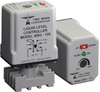
from Time Mark Corporation
The Model 4093 is a compact, socket mounted Liquid Level Controller that operates by monitoring the conductive liquid resistance between two probes. The unit monitors two liquid levels and responds as a pump-up or pump-down control as determined by the switch setting on the top of the unit. The... [See More]
- Type: Resistive/ Potentiometer Inputs
- Features: Rate Indication/ Control
- Control: Limit
- Control Signal: Switched Output

from Florite International, Inc.
The 900 Series is an economic one loop microcomputer-based instrument incorporating user selectable digital and analog inputs, as well as analog and relay outputs. Other 900 Series features include .005% high accuracy PID, batch, and dose control functions. Additionally, the 900 Series encompasses... [See More]
- Type: DC Voltage Inputs; Current Loop (Transmitter) Excitation; Resistive/ Potentiometer Inputs; Switch / Relay Input; Frequency Inputs; Serial / Digital Input; Fieldbus / Network Input; Screw Terminal
- Control: Limit; Linear; Feedforward; PID
- Controller Type: Batch; Flow; Laboratory; Pressure
- Features: PLC; Multi-Function; Datalogger; Is a Chart Recorder; Rate Indication/ Control; Totalizing (Length or Roll Diameter) Indication/ Control