
Multi-Function Controller Level Controllers
Last Updated: April 1, 2025
Description
Multi-Function Controller Level Controllers are devices designed to manage and regulate the level of liquids or other substances within a container or system. They achieve this by taking sensor inputs and providing control functions, such as limits, PID (Proportional, Integral, Derivative) control, and logic, to output a control signal that maintains the desired level.
Working Principle
Multi-Function Controller Level Controllers operate by receiving input from sensors that detect the level of a substance within a tank or vessel. These inputs are processed using control algorithms, such as PID control, which adjust the output signals to maintain the substance at a set level. This control is crucial for ensuring that the process remains within operational parameters, preventing overflows or shortages. The controllers are useful because they can manage multiple processes simultaneously, often featuring on-board relays for alarming or discrete control, and can be adjusted remotely through serial communication capabilities .
Applications
Multi-Function Controller Level Controllers are widely used in various industrial processes where precise level management is critical. Specific examples include:
- Chemical processing plants where maintaining the correct level of reactants in a reactor is essential for safety and product quality.
- Food and beverage industries for managing the levels of liquids in storage tanks to ensure consistent product output.
- Pharmaceutical manufacturing where precise liquid levels are necessary for accurate formulation and mixing processes .
Advantages over other Level Controllers
One of the key advantages of Multi-Function Controller Level Controllers is their ability to control multiple processes simultaneously, which can lead to more efficient and streamlined operations. Additionally, their capability to be programmed for different ranges and outputs makes them versatile for various applications. The inclusion of on-board relays and remote adjustment features further enhances their functionality and ease of use .
Limitations
Despite their advantages, Multi-Function Controller Level Controllers may have limitations such as complexity in setup and programming, which can require specialized knowledge or training. Additionally, they may be more expensive upfront compared to simpler, single-function controllers, which could be a consideration for smaller operations or those with limited budgets.
Considerations
When considering the implementation of Multi-Function Controller Level Controllers, several factors should be taken into account:
- Initial Costs: These controllers may have higher initial costs due to their advanced features and capabilities.
- Operating Expense: While they can improve efficiency, the complexity of these systems might lead to higher operating expenses, particularly if specialized maintenance is required.
- Durability and Accuracy: These controllers are generally durable and provide high accuracy, which is crucial for maintaining process integrity.
- Replacement and Maintenance Costs: Regular maintenance and potential replacement of sensors or components should be factored into the overall cost of ownership.

from Florite International, Inc.
The 900 Series is an economic one loop microcomputer-based instrument incorporating user selectable digital and analog inputs, as well as analog and relay outputs. Other 900 Series features include .005% high accuracy PID, batch, and dose control functions. Additionally, the 900 Series encompasses... [See More]
- Controller Type: Batch; Flow; Laboratory; Pressure
- Features: PLC; Multi-Function; Datalogger; Is a Chart Recorder; Rate Indication/ Control; Totalizing (Length or Roll Diameter) Indication/ Control
- Control: Limit; Linear; Feedforward; PID
- Form Factor: Board (optional feature); Chassis; Rack; Stand-Alone; Wall Mount
from PMC Engineering LLC
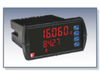
The DPM is a multipurpose, easy to use digital dual-input process meter ideal for level, flow rate, temperature transmitter, or pressure transmitter applications. Various math functions may be applied to the inputs including addition, difference, absolute difference, average, weighted average,... [See More]
- Controller Type: Flow; Pressure
- Features: Multi-Function; Datalogger; Rate Indication/ Control; Totalizing (Length or Roll Diameter) Indication/ Control
- Control: Limit
- Form Factor: Chassis
from Iwaki America and Walchem, IWAKI America Inc
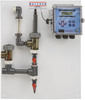
Walchem's WDIS Series controller will reliably and economically control your water treatment disinfection process.The controller includes four standard sensor input options (free chlorine/bromine, chlorine dioxide, ozone and peracetic acid) or can be configured to use a variety of other types of... [See More]
- Controller Type: Laboratory
- Features: Multi-Function; Datalogger
- Control: Limit; Linear; PID; Nonlinear
- Form Factor: Chassis

from Florite International, Inc.
The Florite Model 990X is an innovative, technically superior, high quality and reliable microcomputer-based controller suitable for any commercial or industrial application. The instruments user configurable screw-terminal channels enable any mix of up to eight inputs and or outputs regardless of... [See More]
- Controller Type: Batch; Flow; Laboratory; Pressure
- Features: PLC; Multi-Function; Datalogger; Is a Chart Recorder; Rate Indication/ Control; Totalizing (Length or Roll Diameter) Indication/ Control
- Control: Limit; Linear; Feedforward; PID
- Form Factor: Chassis; Rack; Stand-Alone; Table Top Mount
from PMC Engineering LLC
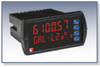
The PM is a multipurpose, easy to use digital process meter ideal for level, flow rate, temperature, or pressure transmitter applications. It accepts current and voltage signals. Three of the front panel buttons can be custom programmed for a specific operation. Dual Scale for Level Applications -... [See More]
- Controller Type: Flow; Pressure
- Features: Multi-Function; Datalogger; Rate Indication/ Control; Totalizing (Length or Roll Diameter) Indication/ Control
- Control: Limit
- Form Factor: Chassis