
Datalogger Level Controllers
Last Updated: April 1, 2025
Description
Datalogger Level Controllers are electronic devices designed to collect and store data related to the level of a substance, typically a liquid, within a container or system. These devices function independently of a computer system and are capable of recording various parameters over time, providing a comprehensive record of level changes.
Working Principle
Datalogger Level Controllers operate by interfacing with sensors that detect the level of a liquid. These sensors provide input signals to the datalogger, which then records the data at specified intervals. The datalogger can be programmed to process this data, evaluate complex alarm logic, and even transmit alerts if certain thresholds are exceeded. This capability makes them particularly useful for continuous monitoring and control in industrial processes, ensuring that levels remain within desired limits and helping to prevent overflows or shortages.
Applications
Datalogger Level Controllers are used in a wide range of industries. For example, in the chemical and pharmaceutical industries, they monitor the levels of reactive substances in storage tanks to ensure safe and efficient operations. In the food and beverage industry, they help maintain the correct levels of ingredients in mixing tanks. Additionally, they are employed in water treatment facilities to monitor and control the levels of water in reservoirs and treatment tanks.
Advantages over other Level Controllers
Datalogger Level Controllers offer several advantages over traditional level controllers. They provide more reliable and accurate data collection, reducing the need for manual measurements and the potential for human error. Their ability to transmit alarms and alerts in real-time allows for immediate response to any deviations from set parameters, minimizing the risk of process disruptions. Furthermore, their capacity to store large amounts of data enables detailed analysis and long-term monitoring.
Limitations
One limitation of Datalogger Level Controllers is their dependency on the sensors' accuracy and reliability. If the sensors are not properly calibrated or maintained, the data collected may be inaccurate. Additionally, while dataloggers can operate independently, they may require periodic maintenance and battery replacement to ensure continuous operation.
Considerations
When considering the implementation of Datalogger Level Controllers, it is important to evaluate the initial costs, which can vary depending on the complexity and capabilities of the system. Operating expenses may include power consumption and data storage costs. Durability is a key factor, as these devices often operate in harsh industrial environments. Accuracy is crucial, and regular calibration of sensors is necessary to maintain it. Replacement and maintenance costs should also be considered, as these can impact the long-term cost-effectiveness of the system.

from BinMaster, Inc.
The BinMaster C-100 control console provides convenient walk up or drive up access to level and volume data indoors or outdoors at the push of a button. The C-100 offers measurements displayed as feet or cubic feet, US gallons or bushels, and tons, metric tons, or kilograms. Measurements can be... [See More]
- Features: PLC; Datalogger; Totalizing (Length or Roll Diameter) Indication/ Control
- Form Factor: Chassis
- Control: Limit
- Interface: Digital Front Panel
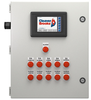
from Cleaver-Brooks
Level control is provided for the DA tank while the surge tank receives feed control, with a bias to limit the valve position according to surge tank level. The system accepts a 4-20 ma input signal from each of the DA and Surge level transmitters. Alarms for both tanks include High-High-, Low-,... [See More]
- Features: PLC; Datalogger
- Form Factor: Stand-Alone
- Control: Limit
- Interface: Switches; Digital Front Panel
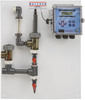
from Iwaki America and Walchem, IWAKI America Inc
Walchem's WDIS Series controller will reliably and economically control your water treatment disinfection process.The controller includes four standard sensor input options (free chlorine/bromine, chlorine dioxide, ozone and peracetic acid) or can be configured to use a variety of other types of... [See More]
- Features: Multi-Function; Datalogger
- Control: Limit; Linear; PID; Nonlinear
- Controller Type: Laboratory
- Form Factor: Chassis

from Florite International, Inc.
The 900 Series is an economic one loop microcomputer-based instrument incorporating user selectable digital and analog inputs, as well as analog and relay outputs. Other 900 Series features include .005% high accuracy PID, batch, and dose control functions. Additionally, the 900 Series encompasses... [See More]
- Features: PLC; Multi-Function; Datalogger; Is a Chart Recorder; Rate Indication/ Control; Totalizing (Length or Roll Diameter) Indication/ Control
- Control: Limit; Linear; Feedforward; PID
- Controller Type: Batch; Flow; Laboratory; Pressure
- Form Factor: Board (optional feature); Chassis; Rack; Stand-Alone; Wall Mount
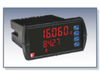
from PMC Engineering LLC
The DPM is a multipurpose, easy to use digital dual-input process meter ideal for level, flow rate, temperature transmitter, or pressure transmitter applications. Various math functions may be applied to the inputs including addition, difference, absolute difference, average, weighted average,... [See More]
- Features: Multi-Function; Datalogger; Rate Indication/ Control; Totalizing (Length or Roll Diameter) Indication/ Control
- Control: Limit
- Controller Type: Flow; Pressure
- Form Factor: Chassis