
Pressure Controller Level Controllers
Last Updated: April 1, 2025
Description
Pressure Controller Level Controllers are devices designed to regulate pressure within a system to maintain a desired level. They receive inputs from pressure sensors and output control signals to adjust the pressure accordingly. These controllers are essential in ensuring that the pressure within a system remains within specified limits, thereby maintaining the desired level of a liquid or gas.
Working Principle
Pressure Controller Level Controllers operate by receiving inputs from pressure sensors that monitor the current pressure within a system. They use various control strategies, such as proportional, integral, and derivative (PID) control, to process these inputs and determine the necessary adjustments. The controller then outputs a control signal to a valve or actuator, which adjusts the pressure to maintain the desired level. This closed-loop system is crucial for maintaining stability and preventing fluctuations that could disrupt the process.
Applications
Pressure Controller Level Controllers are used in a variety of industrial applications. For example, they are employed in chemical processing plants to maintain the pressure of gases like oxygen and nitrogen, ensuring safe and efficient operations. They are also used in the food and beverage industry to control the pressure in storage tanks, preventing spoilage and maintaining product quality.
Advantages over other Level Controllers
One of the key advantages of Pressure Controller Level Controllers over other types of level controllers is their ability to provide precise control over pressure, which is critical in processes where maintaining a specific pressure is essential for safety and efficiency. Unlike simple on/off level switches, these controllers can adjust the pressure dynamically, providing a more stable and reliable control solution.
Limitations
A limitation of Pressure Controller Level Controllers is that they can be complex to set up and require careful calibration to ensure accurate performance. Additionally, they may not be suitable for applications where rapid changes in pressure are required, as the control loop may introduce delays.
Considerations
When selecting a Pressure Controller Level Controller, it is important to consider factors such as initial costs, operating expenses, and maintenance requirements. These controllers can be more expensive than simpler level control solutions, but their precision and reliability can justify the investment in critical applications. Durability and accuracy are also important considerations, as these factors will impact the long-term performance and maintenance costs of the system. Regular maintenance and calibration are necessary to ensure the controller continues to operate effectively and accurately.

from Florite International, Inc.
The 900 Series is an economic one loop microcomputer-based instrument incorporating user selectable digital and analog inputs, as well as analog and relay outputs. Other 900 Series features include .005% high accuracy PID, batch, and dose control functions. Additionally, the 900 Series encompasses... [See More]
- Controller Type: Batch; Flow; Laboratory; Pressure
- Features: PLC; Multi-Function; Datalogger; Is a Chart Recorder; Rate Indication/ Control; Totalizing (Length or Roll Diameter) Indication/ Control
- Control: Limit; Linear; Feedforward; PID
- Form Factor: Board (optional feature); Chassis; Rack; Stand-Alone; Wall Mount

from Barksdale Control Products
Barksdale's UAS3 Electronic Trip Amplifier and controller is the perfect companion to any sensing device that provides a 4-20 mA or 0-10 VDC analog output. Our UAS3 offers the unique ability to switch four discrete circuits in a single, compact unit. In addition to its four SPDT relays, the UAS3... [See More]
- Controller Type: Pressure
- Interface: Digital Front Panel
- Control: Limit
- Inputs: 1
from Time Mark Corporation
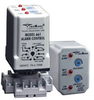
The Model 661 Alarm Control, part of the 600 series line of instrumentation controls, is designed to monitor and maintain measurable applications such as liquid levels, temperature, pressure, flow, etc. A user-provided 4-20mA current loop represents the measurable application, and output connections... [See More]
- Controller Type: Flow; Pressure
- Features: Rate Indication/ Control
- Control: Limit
- Type: Current Loop (Transmitter) Excitation
from PMC Engineering LLC
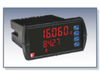
The DPM is a multipurpose, easy to use digital dual-input process meter ideal for level, flow rate, temperature transmitter, or pressure transmitter applications. Various math functions may be applied to the inputs including addition, difference, absolute difference, average, weighted average,... [See More]
- Controller Type: Flow; Pressure
- Features: Multi-Function; Datalogger; Rate Indication/ Control; Totalizing (Length or Roll Diameter) Indication/ Control
- Control: Limit
- Form Factor: Chassis