
λ/20 Optical Mirrors
Last Updated: April 1, 2025
Description
?/20 Optical Mirrors are precision optical components designed to reflect light with extremely high accuracy. These mirrors are characterized by their surface quality, which is specified as ?/20, indicating that the surface deviation from a perfect flatness is less than one-twentieth of the wavelength of light used. This high level of precision ensures minimal distortion in the reflected light, making them suitable for applications requiring exacting optical performance.
Working Principle
The working principle of ?/20 Optical Mirrors is based on their ability to reflect light with minimal wavefront distortion. The ?/20 specification refers to the mirror's surface accuracy, which is crucial for maintaining the integrity of the reflected wavefront. This precision is achieved through meticulous manufacturing processes that ensure the mirror's surface deviates minimally from a perfect plane. The high surface accuracy allows these mirrors to reflect light with high fidelity, preserving the wavefront's original characteristics. This makes them particularly useful in applications where optical precision is paramount, such as in scientific research and high-resolution imaging systems.
Applications
While specific applications for ?/20 Optical Mirrors are not detailed in the provided documents, such mirrors are typically used in environments where high precision is required. This includes scientific research laboratories, high-resolution imaging systems, and advanced optical instruments. They are often employed in applications such as laser systems, interferometry, and astronomical telescopes, where maintaining the integrity of the light wavefront is critical.
Advantages over other Optical Mirrors
The primary advantage of ?/20 Optical Mirrors over other optical mirrors lies in their superior surface accuracy. This high level of precision ensures that the reflected light experiences minimal distortion, which is crucial for applications requiring exacting optical performance. Compared to mirrors with lower surface accuracy, ?/20 mirrors provide enhanced image clarity and resolution, making them ideal for high-precision optical systems.
Limitations
Specific limitations of ?/20 Optical Mirrors are not detailed in the provided documents. However, it can be inferred that the high precision of these mirrors may come with challenges such as increased manufacturing complexity and cost. Additionally, maintaining the surface accuracy over time may require careful handling and environmental control to prevent degradation.
Considerations
When considering ?/20 Optical Mirrors, several factors should be taken into account. The initial cost of these mirrors is likely higher due to the precision manufacturing processes involved. Operating expenses may include the need for controlled environments to maintain the mirror's surface accuracy. Durability is a consideration, as the high precision surface may be susceptible to damage from environmental factors or improper handling. Accuracy is a key benefit, but it requires regular maintenance and potential recalibration to ensure continued performance. Replacement and maintenance costs should also be considered, as maintaining the mirror's precision may necessitate specialized services.

from Newport MKS
The 10Z40ER.1 Broadband Aluminum Mirror is an excellent general purpose, broadband reflector. This 25.4 mm (1.0 inch) diameter mirror is made from a 6.0 mm thick Zerodur substrate. Zerodur, a glass-ceramic material, exhibits nominally zero thermal expansion which provides extra stability for... [See More]
- Surface Flatness: λ/20
- Diameter/Width: 25.4
- Wavelength Range: 450 to 700
- Thickness: 6

from Newport MKS
The 40Z40BD.2 Broadband Dielectric Mirror is an extremely versatile mirror for laboratory applications and highly efficient over a broad wavelength range. This 4 inch (101.6 mm) diameter mirror is made from a 17.7 mm thick Zerodur substrate. Zerodur is a glass-ceramic material where thermal... [See More]
- Surface Flatness: λ/20
- Diameter/Width: 102
- Wavelength Range: 700 to 950
- Thickness: 17.7

from Newport MKS
The 40Z40BD.1 Broadband Dielectric Mirror is an extremely versatile mirror for laboratory applications and highly efficient over a broad wavelength range. This 4 inch (101.6 mm) diameter mirror is made from a 17.7 mm thick Zerodur substrate. Zerodur is a glass-ceramic material where thermal... [See More]
- Surface Flatness: λ/20
- Diameter/Width: 102
- Wavelength Range: 488 to 694
- Thickness: 17.7

from Newport MKS
The 10Z40BD.1 Broadband Dielectric Mirror is an extremely versatile mirror for laboratory applications and highly efficient over a broad wavelength range. This 1 inch (25.4 mm) diameter mirror is made from a 6.0 mm thick Zerodur substrate. Zerodur is a glass-ceramic material where thermal expansion... [See More]
- Surface Flatness: λ/20
- Diameter/Width: 25.4
- Wavelength Range: 488 to 694
- Thickness: 6

from Newport MKS
The 10Z40BD.2 Broadband Dielectric Mirror is an extremely versatile mirror for laboratory applications and highly efficient over a broad wavelength range. This 1 inch (25.4 mm) diameter mirror is made from a 6.0 mm thick Zerodur substrate. Zerodur is a glass-ceramic material where thermal expansion... [See More]
- Surface Flatness: λ/20
- Diameter/Width: 25.4
- Wavelength Range: 700 to 950
- Thickness: 6

from Newport MKS
The 10Z40DM.10 Laser Line Dielectric mirror is a highly efficient reflector optimized for a narrow 1030 to 1090 nm wavelength range. This 1 inch (25.4 mm) diameter mirror is made from a 6.0 mm thick Zerodur substrate. Zerodur is a glass-ceramic material where thermal expansion is nominally zero. [See More]
- Surface Flatness: λ/20
- Wavelength Range: 1030 to 1090
- Mirror Types: Laser Mirror
- Diameter/Width: 25.4

from Newport MKS
The 10Z40DM.8 Laser Line Dielectric mirror is a highly efficient reflector optimized for a narrow 1520 to 1580 nm wavelength range. This 1 inch (25.4 mm) diameter mirror is made from a 6.0 mm thick Zerodur substrate. Zerodur is a glass-ceramic material where thermal expansion is nominally zero. This... [See More]
- Surface Flatness: λ/20
- Wavelength Range: 1520 to 1580
- Mirror Types: Laser Mirror
- Diameter/Width: 25.4

from Newport MKS
The 10Z40DM.4 Laser Line Dielectric mirror is a highly efficient reflector optimized for the 632.8 nm wavelength. This 1 inch (25.4 mm) diameter mirror is made from a 6.0 mm thick Zerodur substrate. Zerodur is a glass-ceramic material where thermal expansion is nominally zero. This extra stability... [See More]
- Surface Flatness: λ/20
- Wavelength Range: 633
- Mirror Types: Laser Mirror
- Diameter/Width: 25.4

from Newport MKS
The 10Z40ER.4 Broadband Gold Mirror is an excellent general purpose, broadband reflector. This 25.4 mm (1.0 inch) diameter mirror is made from a 6.0 mm thick Zerodur substrate. Zerodur, a glass-ceramic material, exhibits nominally zero thermal expansion which provides extra stability for... [See More]
- Surface Flatness: λ/20
- Diameter/Width: 25.4
- Wavelength Range: 650 to 20000
- Thickness: 6

from Rocky Mountain Instrument/RMI Laser
Mirrors are used in a wide range of beam steering, focusing and collimating applications. Broadband RMAX Mirrors provide high reflectance over a broad spectral range. They are also useful in narrowband applications in which it is necessary to vary the angle of incidence. Substrates are available... [See More]
- Surface Flatness: λ/4; λ/20; lambda/40
- Mirror Shape: Round
- Mirror Types: Flat Mirror; Plano/Convex, Plano/Concave
- Mirror Materials: BK7 Glass; Fused Silica; Ultra-violet grade Fused Silica; Calcium Flouride

from Thorlabs, Inc.
At Thorlabs, we constantly reinforce our desire to serve at the pleasure of our customers. From this comes our desire to be connected to our industry in a way that far exceeds what would typically be expected of a vendor. Thorlabs lives this core principle by seeking to enhance, at every turn, the... [See More]
- Surface Flatness: λ/10; λ/20
- Wavelength Range: 250 to 20000
- Mirror Types: Laser Mirror
- Diameter/Width: 12.7 to 50.8
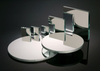
from Advanced Optics, Inc.
Front surface optical mirrors (also known as first surface optical mirrors) reflect light directly from the coating that is applied to the polished or working surface of the mirror. Front surface optical mirrors differ from second surface optical mirrors in the fact that light does not have to... [See More]
- Surface Flatness: λ/20
- Mirror Shape: Rectangular / Square
- Mirror Types: Flat Mirror
- Mirror Coatings: Uncoated (optional feature); Aluminum (optional feature); Enhanced Aluminum (optional feature); Gold (optional feature); Protected Gold (optional feature); Custom Coating
from Edmund Optics Inc.
1/4 λ, 1/10 λ and 1/20 λ Surface Flatness Options. Certified with a Zygo Interferometer. Each 1/20 λ Flat Includes a Certificate of Calibration. Single Surface Optical Flats Also Available. Our dual surface optical flats are precision ground and polished to the stated... [See More]
- Surface Flatness: λ/20
- Diameter/Width: 25.4
- Mirror Types: Flat Mirror
- Thickness: 12.7

from Rocky Mountain Instrument/RMI Laser
Mirrors are used in a wide range of beam steering, focusing and collimating applications. RMAX Mirrors utilize multi-layer, dielectric thin films. Laser-Line RMAX Mirrors are designed for high reflectance at a single laser wavelength. High power coating designs are standard for select wavelengths. [See More]
- Surface Flatness: λ/4; λ/20; lambda/40
- Mirror Shape: Round
- Mirror Types: Laser Mirror
- Mirror Materials: BK7 Glass; Fused Silica; Ultra-violet grade Fused Silica; Calcium Flouride
from Thorlabs, Inc.
At Thorlabs, we constantly reinforce our desire to serve at the pleasure of our customers. From this comes our desire to be connected to our industry in a way that far exceeds what would typically be expected of a vendor. Thorlabs lives this core principle by seeking to enhance, at every turn, the... [See More]
- Surface Flatness: λ/5; λ/8; λ/10; λ/20
- Wavelength Range: 250 to 20000
- Mirror Types: Flat Mirror
- Diameter/Width: 7 to 102

from Advanced Optics, Inc.
Optical mirrors made of ZERODUR ® provide a very low coefficient of thermal expansion making this glass-ceramic material ideal for applications where the optical mirror is exposed to fluctuating and/or extremely cold temperatures. Although ZERODUR ® has an overall yellowish tint, it has good... [See More]
- Surface Flatness: λ/20
- Mirror Shape: Round
- Mirror Types: Flat Mirror
- Mirror Materials: Zerodur®
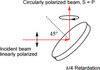
from Rocky Mountain Instrument/RMI Laser
Phase Retarding Mirrors are designed to produce a specific phase shift between the S and P polarization components of an incident CO2 laser beam. Mirrors designed for zero phase shift maintain the incident polarization state in the reflected beam. Mirrors designed for λ/4 (90 º) phase... [See More]
- Surface Flatness: λ/20; lambda/40
- Mirror Shape: Round
- Mirror Types: Flat Mirror
- Mirror Materials: Copper; Silicon
from Thorlabs, Inc.
At Thorlabs, we constantly reinforce our desire to serve at the pleasure of our customers. From this comes our desire to be connected to our industry in a way that far exceeds what would typically be expected of a vendor. Thorlabs lives this core principle by seeking to enhance, at every turn, the... [See More]
- Surface Flatness: λ/2; λ/4; λ/8; λ/10; λ/20; ?/6
- Wavelength Range: 355 to 2250
- Mirror Types: Laser Mirror
- Diameter/Width: 12.7 to 50.8