
Copper Optical Mirrors
Last Updated: April 1, 2025
Description
Copper optical mirrors are reflective surfaces made from copper, designed to reflect light with high efficiency. These mirrors are characterized by their high reflectivity and are often used in environments where thermal conductivity is crucial.
Working Principle
Copper optical mirrors work by reflecting light off their polished surfaces. The high thermal conductivity of copper makes these mirrors particularly useful in high-power applications, as they can efficiently dissipate heat. This property helps maintain the integrity of the mirror's reflective surface, ensuring consistent performance over time. The reflectivity of copper mirrors is enhanced by their ability to handle high-frequency electromagnetic waves, making them suitable for specific optical tasks.
Applications
Copper optical mirrors are used in applications that require high thermal management and reflectivity. They are particularly effective in shielding high-frequency electromagnetic waves, which makes them valuable in communication applications. Additionally, their high reflectivity is beneficial in environments where precise light manipulation is necessary, such as in certain types of laser systems.
Advantages over other Optical Mirrors
Copper mirrors offer distinct advantages over other types of optical mirrors due to their high thermal conductivity. This property allows them to perform well in high-power environments where heat dissipation is critical. Unlike some other metallic mirrors, copper mirrors can handle high-frequency electromagnetic waves, making them suitable for specialized communication applications.
Limitations
One of the primary limitations of copper optical mirrors is their susceptibility to oxidation. Without proper protective coatings, the reflective surface can degrade over time, affecting performance. This oxidation can lead to a decrease in reflectivity and potential discoloration, which can compromise the mirror's effectiveness in optical applications.
Considerations
When considering copper optical mirrors, it is important to factor in the initial costs and potential operating expenses associated with maintaining their reflective quality. The need for protective coatings to prevent oxidation can increase both the initial investment and ongoing maintenance costs. Additionally, while copper mirrors are durable in terms of thermal management, their susceptibility to surface degradation requires careful handling and regular maintenance to ensure long-term accuracy and performance.
from Electro Optical Components, Inc.
Flat mirrors find wide uses in industrial laser systems, as well as medical, scientific and research applications. Copper based mirrors in particular provide a rugged and durable mirror with good reflectivity across a broad spectrum of the infrared. Our electroplated gold coating offers good... [See More]
- Mirror Materials: Copper; Fused Silica; Aluminum, Molybdenum
- Mirror Types: Flat Mirror; Laser Mirror
from Ophir-Spiricon Inc.
Plano surface curve [See More]
- Mirror Materials: Copper
- Diameter/Width: 50.8
- Mirror Types: Laser Mirror
- Thickness: 5.08

from Thorlabs, Inc.
At Thorlabs, we constantly reinforce our desire to serve at the pleasure of our customers. From this comes our desire to be connected to our industry in a way that far exceeds what would typically be expected of a vendor. Thorlabs lives this core principle by seeking to enhance, at every turn, the... [See More]
- Mirror Materials: Copper; Fused Silica
- Wavelength Range: 250 to 20000
- Mirror Types: Laser Mirror
- Diameter/Width: 12.7 to 50.8

from Rocky Mountain Instrument/RMI Laser
Mirrors are used in a wide range of beam steering, focusing, and collimating applications. Metal Mirrors are intended for applications involving lower power lasers or broadband sources. They are less sensitive to wavelength, polarization and angle of incidence than dielectric mirrors. Solid Metal... [See More]
- Mirror Materials: Copper; Aluminum, Silver, Gold
- Mirror Shape: Round
- Mirror Types: Flat Mirror; Plano/Convex, Plano/Concave
- Mirror Coatings: Uncoated

from Shanghai Optics
Like household mirrors, copper and aluminum optical mirrors are designed to reflect light. Unlike the typical mirror, however, which is painted with a thin layer of metal on the back of a glass substrate, optical mirrors are coated on the front, rendering them more reflective and more accurate in... [See More]
- Mirror Materials: Copper
- Mirror Types: Flat Mirror; Laser Mirror
from Thorlabs, Inc.
At Thorlabs, we constantly reinforce our desire to serve at the pleasure of our customers. From this comes our desire to be connected to our industry in a way that far exceeds what would typically be expected of a vendor. Thorlabs lives this core principle by seeking to enhance, at every turn, the... [See More]
- Mirror Materials: Copper; Fused Silica; Ultra-violet grade Fused Silica; Zerodur®
- Wavelength Range: 250 to 20000
- Mirror Types: Flat Mirror
- Diameter/Width: 7 to 102
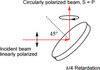
from Rocky Mountain Instrument/RMI Laser
Phase Retarding Mirrors are designed to produce a specific phase shift between the S and P polarization components of an incident CO2 laser beam. Mirrors designed for zero phase shift maintain the incident polarization state in the reflected beam. Mirrors designed for λ/4 (90 º) phase... [See More]
- Mirror Materials: Copper; Silicon
- Mirror Shape: Round
- Mirror Types: Flat Mirror
- Surface Quality: 40-20 Scratch / Dig; Fine Grind