
Tubular Wire Filler Alloys and Consumables
Last Updated: February 12, 2025
Description
Tubular wire filler alloys and consumables are metallic materials used in welding processes to join two or more metal components. These products are designed to flow across the base metals and adjoin them effectively, ensuring a strong and durable bond. They are typically composed of multiple metals to achieve the desired viscosity and melting characteristics, which are crucial for sealing tolerances between substrates.
Working Principle
Tubular wire filler alloys work by melting at a temperature below that of the base metals, allowing them to flow into the joint and create a bond upon cooling. The tubular structure of these wires often contains flux or other materials that aid in the welding process by cleaning the metal surfaces and preventing oxidation. This design enhances the efficiency of the welding process, making these fillers particularly useful for applications requiring precise and strong joints.
Applications
Tubular wire filler alloys are commonly used in various welding applications, including the joining of pipes and tubes in industries such as oil and gas, automotive, and aerospace. They are particularly effective in situations where the base metals have large gaps or require a filler that can withstand high mechanical stresses. Specific examples include the welding of stainless steel pipes in chemical processing plants and the repair of automotive exhaust systems.
Advantages over other Filler Alloys and Consumables
One of the primary advantages of tubular wire filler alloys is their ability to accommodate larger gaps between base metals, which is not always possible with solid wire fillers. Additionally, the inclusion of flux within the tubular structure can reduce the need for external flux, simplifying the welding process and reducing cleanup time. This can lead to increased productivity and cost savings in industrial applications.
Limitations
Despite their advantages, tubular wire filler alloys have limitations. They may not be suitable for all types of metals or welding conditions, particularly where extremely high precision is required. The presence of flux within the wire can also lead to slag formation, which may need to be removed post-welding, adding an extra step to the process.
Considerations
When selecting tubular wire filler alloys, it is important to consider factors such as initial costs, operating expenses, and the specific requirements of the welding application. While these fillers can offer cost savings in terms of reduced flux usage and increased productivity, they may also incur higher initial costs compared to solid wire fillers. Durability and maintenance costs should also be evaluated, as the presence of flux can affect the longevity of the weld and the need for additional cleaning or repairs.

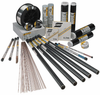
from Hobart Brothers, an ITW Company
Brand. McKAY ®. Category. Build-Up Submerged Arc Metal-Cored Wires. Description. This is a low alloy steel deposit. Designed for build up on mild and low alloy steels only. Has good compressive strength and impact resistance making it an excellent base for abrasion resistant alloys. [See More]
- Joining Process / Product Form: Hollow wire or metal cored filler
- Welding Filler Types: Hardfacing / Repair Alloy
- Diameter / Thickness: 0.0938
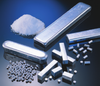
from ESAB Welding and Cutting Products
Features. All-position AC/DC reverse nickel electrode for heavy sections of cast iron and ductile iron. For production welding requiring machinable deposits with high strength and good ductility. Good color match. Meets AWS A5.15, Class ENiFe-Cl-A [See More]
- Joining Process / Product Form: Flux Cored Wire; Hollow wire or metal cored filler
- Yield Strength (YS): 60000
- Tensile Strength (UTS): 80000
- Elongation: 12
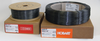
from Indium Corporation
Indium Corporation is the leading global supplier of commercial indium, high purity indium, indium fabrications, alloys, and chemicals. Indium metal is extracted from indium-bearing ore and is refined to various grades in high volume utilizing state of the art SPC controlled refining technologies. [See More]
- Joining Process / Product Form: Braze or solder in the form of a paste.; Filler braze or solder alloy in a reconfigured sheet form that fits the contour of the joint surfaces.; Strip, sheet or foil; Solid wire or rod; Hollow wire or metal cored filler
- Solder Alloy: Indium Alloy Solders
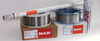
from Hobart Brothers, an ITW Company
Brand. HOBART ®. Category. Gas-Shielded Wires, Carbon Steel, Flat and Horizontal. Description. Metal-cored gas-shielded wire combining the high deposition rates of a flux-cored wire with the high efficiencies of a solid wire. Will improve productivity through increased deposition rates and... [See More]
- Joining Process / Product Form: Hollow wire or metal cored filler
- Welding Filler Types: Carbon Steel
- Diameter / Thickness: 0.0625
- Weld Positions: Flat; Horizontal
from Hobart Brothers, an ITW Company
Brand. HOBART ®. Category. Stainless Metal-Cored, Gas-Shielded Wires, Flat and Horizontal. Description. Stainless metal cored wire designed for welding of 439 where corrosion, erosion, and abrasion at elevated temperatures is required. Applications. Single and multiple pass applications with a... [See More]
- Joining Process / Product Form: Hollow wire or metal cored filler
- Welding Filler Types: Steel - Stainless
- Diameter / Thickness: 0.0450
- Weld Positions: Flat; Horizontal

from Hobart Brothers, an ITW Company
Brand. TRI-MARK ®. Category. Submerged Arc Metal-Cored Wires. Description. Metalloy EM13KS is a composite electrode for submerged arc welding of carbon steel plates using the recommended fluxes. The electrode chemistry conforms to the solid wire classification EM13K per AWS A5.17. Applications. [See More]
- Joining Process / Product Form: Hollow wire or metal cored filler
- Diameter / Thickness: 0.0781