
Industrial Joysticks Information
Last revised: February 18, 2025
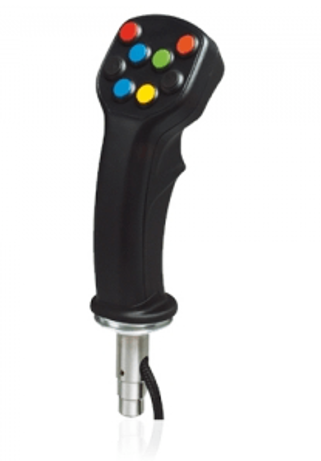
Industrial joysticks use potentiometric, inductive, or photoelectric sensing systems and/or switches to translate joystick motion into an output signal. They are usually made from plastic, nylon, nylon plastic, glass-filled nylon, or stainless steel. Several types of joystick controllers are available. Industrial joysticks are used in demanding environmental conditions or with heavy-duty equipment such as:
- forklifts
- cranes
- agricultural machinery
- hoist devices
- vehicle steering
- excavators
- municipal or military vehicles
Precision joystick controllers are used for steering, positioning, and speed control in applications such as microscope control. They are also used in camera controls, wheel chairs, surveillance cameras, optical measurement equipment, medical diagnostic equipment, and stage techniques. Game joysticks are used in flight simulators, video games, and remote controls.
Specifications
Specifications for joystick controllers include number of axes, friction hold, spring return, and protocol support. There are six degrees of freedom (DOF) corresponding to the axes of the direction of movement. The possible directions are x, y, z, yaw, pitch, and roll. Joystick controllers with between one and six axes are commonly available. Devices with friction-hold features latch the switching lever in the selected position. Spring return or centering returns the device to the center position due to mechanical or programmable spring force. In terms of protocol support, many types of connectors are available. Examples include universal serial bus (USB), CANbus, PROFIBUS, and pulse width modulation (PWM). DB-15 is game port connector on many older sound cards. RS232 is a standard serial interface between data terminal equipment and data communications equipment.
Types
Industrial joysticks are used with several types of joysticks.
Inductive joysticks have a magnetic coil connected to the bottom of the grip shaft, directly over four other magnetic coils mounted on a circuit board in the base. Deflection moves the shaft-mounted magnetic coil over the four stationary coils, causing a change in the magnetic waveform patterns.
Resistive joysticks use potentiometers mounted to spring loaded bails that are moved by a deflection of the joystick handle. The outputs are read as either a change in voltage or a change in electrical resistance.
Hybrid joysticks combine both inductive and resistive technologies.
By contrast, optical joysticks use a non-contact photoelectronic switch instead of conventional contacting switches or potentiometers.
Some joysticks use microswitches, small switches that have a button that, when pressed, closes the switch. Others use non-contacting Hall Effect sensors or other input technologies.
Features
Industrial joysticks vary in terms of handle options, mounting styles, and special features. Many joystick grips are straight or conical tubes, contoured to fit the hand, or shaped like a ball. Multifunction grips are usually actuated with a rocker switch, push-button, thumbwheel, or trigger. Some joysticks mount on a panel or desktop. Others are portable or part of an original equipment manufacturer (OEM) kit. Features for joystick controllers include bellows, gaiters, or boots; shielding from electromagnetic interference (EMI) and radio frequency interference (RFI); protection against electrostatic discharge (ESD); and temperature compensation. Force feedback provides tactile sensations via resistance, recoil, vibration, axis force, or vector force. Mechanical interlocks are switchable pins that are used to ensure that a plug cannot be engaged or disengaged under load.
Industrial Joysticks FAQs
What are the key specifications to consider when selecting an industrial joystick for a specific application?
When selecting an industrial joystick for a specific application, there are several key specifications to consider.
Number of Axes and Degrees of Freedom (DOF)
Joystick controllers can have between one and six axes, corresponding to the six degrees of freedom: x, y, z, yaw, pitch, and roll. The number of axes required will depend on the complexity of the application.
Return Mechanism
Consider whether the joystick has a friction hold, which latches the switching lever in the selected position, or a spring return, which returns the device to the center position due to mechanical or programmable spring force.
Protocol Support
Ensure compatibility with the required communication protocols. Common options include USB, CANbus, PROFIBUS, and PWM. Older systems might use a DB-15 game port connector or RS232 standard serial interface.
Handle Options and Mounting Styles
Joysticks come with various handle designs such as straight, conical, contoured, or ball-shaped. Mounting styles can be panel, desktop, portable, or part of an OEM kit.
Environmental Protection
Features like bellows, gaiters, or boots can provide protection against environmental factors. Look for shielding from electromagnetic interference (EMI), radio frequency interference (RFI), and electrostatic discharge (ESD). Temperature compensation might also be necessary depending on the operating environment.
Force Feedback and Mechanical Interlocks
Some joysticks offer force feedback for tactile sensations via resistance, recoil, vibration, axis force, or vector force. Mechanical interlocks can ensure that a plug cannot be engaged or disengaged under load.
Durability and Resilience
Consider the joystick's static resilience and the materials used for construction, such as stainless steel shafts for strength and durability.
Additional Features
Some joysticks may include multifunction grips with additional control options like rocker switches, push-buttons, thumbwheels, or triggers.
What are the advantages of using inductive versus resistive joysticks?
Inductive Joysticks
Durability and Reliability: Inductive joysticks are known for their durability due to the lack of moving electronic parts, which can reduce wear and tear over time. This can lead to a longer lifespan and less maintenance compared to resistive joysticks.
Fast Response Times: Inductive sensors, which are a key component of inductive joysticks, generally offer fast response times, making them suitable for applications requiring quick and precise control.
Non-Contact Operation: The operation of inductive joysticks involves magnetic coils, which means there is no physical contact between moving parts. This can enhance the reliability and longevity of the device by minimizing mechanical wear.
Resistive Joysticks
Simplicity and Cost-Effectiveness: Resistive joysticks use potentiometers to detect movement, which can be a simpler and more cost-effective solution for applications where high precision and durability are not critical.
Voltage or Resistance Output: The outputs from resistive joysticks are typically read as changes in voltage or electrical resistance, which can be easily integrated into many existing systems without the need for complex signal processing.
What are the environmental protection features of industrial joysticks?
When it comes to the environmental protection features of industrial joysticks, several aspects are designed to ensure their durability and reliability in various operating conditions.
Protective Enclosures
Industrial joysticks often come with protective features such as bellows, gaiters, or boots. These components help shield the internal mechanisms from dust, moisture, and other environmental contaminants.
Shielding from Interference
Many industrial joysticks are equipped with shielding to protect against electromagnetic interference (EMI) and radio frequency interference (RFI). This is crucial for maintaining signal integrity and ensuring reliable operation in environments with high levels of electromagnetic activity.
Protection Against Electrostatic Discharge (ESD)
Joysticks may include features to guard against electrostatic discharge, which can damage electronic components. This protection is essential in environments where static electricity is a concern.
Temperature Compensation
Some joysticks are designed with temperature compensation features to ensure consistent performance across a range of operating temperatures. This is particularly important in environments with significant temperature fluctuations.
Ingress Protection (IP) Ratings
Certain joysticks, such as those mentioned in the technical articles, are designed to meet specific ingress protection (IP) ratings, like IP67. This indicates a high level of protection against dust and water ingress, making them suitable for harsh environments.
How do hybrid joysticks combine inductive and resistive technologies?
Hybrid joysticks combine inductive and resistive technologies to leverage the benefits of both systems. Here's how they work together:
Inductive Technology
Inductive joysticks use magnetic coils to detect movement. A magnetic coil is connected to the bottom of the joystick's grip shaft, positioned over four stationary coils on a circuit board. When the joystick is deflected, the movement alters the magnetic waveform patterns, which are then interpreted as positional data.
Resistive Technology
Resistive joysticks utilize potentiometers that detect movement through changes in voltage or electrical resistance. The joystick handle's deflection moves spring-loaded bails connected to these potentiometers, providing a straightforward and cost-effective method for position sensing.
Combination in Hybrid Joysticks
Hybrid joysticks integrate both inductive and resistive elements to enhance performance. This combination allows for the durability and fast response times of inductive sensors, alongside the simplicity and cost-effectiveness of resistive sensors. The hybrid approach can offer improved reliability and precision, making it suitable for applications that demand both robust performance and economic feasibility.
What are the challenges in designing hybrid joysticks?
Designing hybrid joysticks, which combine inductive and resistive technologies, presents several challenges.
Integration of Technologies
Combining inductive and resistive elements requires careful integration to ensure that both technologies work harmoniously. This involves aligning the magnetic coil systems of inductive sensors with the potentiometer-based systems of resistive sensors, which can be complex.
Signal Processing
Hybrid joysticks must effectively process signals from both inductive and resistive components. This can involve complex signal conditioning and processing to ensure accurate and reliable output, which may require advanced electronics and software.
Cost and Complexity
The integration of two different sensing technologies can increase the cost and complexity of the joystick design. This might involve additional components and more sophisticated manufacturing processes, potentially impacting the overall cost-effectiveness.
Durability and Reliability
Ensuring the durability and reliability of hybrid joysticks can be challenging, as the combination of technologies must withstand various environmental conditions and mechanical stresses. This requires robust design and testing to ensure long-term performance.
Calibration and Maintenance
Hybrid joysticks may require more frequent calibration and maintenance to ensure that both inductive and resistive components are functioning correctly. This can add to the operational complexity and maintenance costs.
What are the latest advancements in joystick technology?
Folding Tactile Joystick
Developed by EPFL startup Foldaway Haptics, this joystick brings haptic feedback to portable devices, drones, and virtual reality controls. It allows users to feel the texture, stiffness, and shape of virtual objects through force feedback.
The device is ultralight and can be plugged directly into a computer or mobile phone, adding a new dimension to applications.
It features an origami-like folding mechanism, making it less than two millimeters thick when folded flat, yet stable and solid due to the composite materials used in its construction.
Hybrid Joysticks
These joysticks combine inductive and resistive technologies to enhance performance. The integration allows for the durability and fast response times of inductive sensors, alongside the simplicity and cost-effectiveness of resistive sensors.
Contactless Sensor Technology
The INDRES sensor principle, which combines inductive and resistive elements, offers a contactless and virtually wear-free operation. This technology is particularly suitable for applications with demanding dynamics requirements, such as in the automotive industry.
These advancements highlight the ongoing innovation in joystick technology, focusing on enhancing user experience, durability, and integration with modern devices.
What are the benefits of using contactless sensor technology in joysticks?
Contactless sensor technology in joysticks offers several benefits, particularly in terms of durability, precision, and maintenance.
Wear-Free Operation
Contactless sensors, such as those using the inductive-resistive principle, operate without physical contact between moving parts. This results in virtually wear-free operation, enhancing the longevity and reliability of the joystick.
Durability and Reliability
The absence of moving electronic parts or magnets in contactless sensors reduces the risk of mechanical failure, making them more durable and reliable over time. This is particularly beneficial in applications with demanding dynamics requirements.
Fast Response Times
Inductive sensors, a type of contactless technology, are known for their fast response times. This makes them suitable for applications requiring quick and precise control.
Reduced Maintenance
Since contactless sensors do not suffer from mechanical wear, they typically require less maintenance compared to traditional resistive sensors. This can lead to cost savings and reduced downtime in industrial applications.
Precision and Accuracy
Contactless sensors can provide high precision and accuracy in position and angle measurements, which is crucial for applications that demand precise control.
These benefits make contactless sensor technology an attractive option for modern joystick designs, especially in environments where durability and precision are critical.
How are contactless sensors integrated into the design of joysticks?
The integration of contactless sensors in joystick design offers several advantages and involves specific considerations to ensure optimal performance.
Contactless Sensor Technology
Contactless sensors, such as those using the inductive-resistive principle, operate without physical contact between moving parts. This results in virtually wear-free operation, enhancing the longevity and reliability of the joystick.
Benefits of Contactless Sensors
Durability and Reliability: The absence of moving electronic parts reduces the risk of mechanical failure, making these sensors more durable and reliable over time.
Fast Response Times: Inductive sensors, a type of contactless technology, are known for their fast response times, making them suitable for applications requiring quick and precise control.
Reduced Maintenance: Since contactless sensors do not suffer from mechanical wear, they typically require less maintenance compared to traditional resistive sensors, leading to cost savings and reduced downtime.
Precision and Accuracy: These sensors provide high precision and accuracy in position and angle measurements, which is crucial for applications that demand precise control.
Integration Challenges
Signal Processing: Effective integration requires complex signal conditioning and processing to ensure accurate and reliable output, which may involve advanced electronics and software.
Cost and Complexity: The integration of contactless sensor technology can increase the cost and complexity of the joystick design, potentially impacting the overall cost-effectiveness.
Industrial Joysticks Media Gallery
References
Electronics360—Watch: Folding Tactile Joystick Brings Haptics to Portable Devices
GlobalSpec—Smartwatch Prototype Uses Wrist as a Joystick
- 1-Axis Control
- 2-Axis Control
- 3-Axis Control
- 4-Axis Control
- 5-Axis Control
- Ball
- Bellows, Gaiter or Boot
- CANbus
- Contoured
- Custom
- Desktop
- EMI / RFI Protection
- Friction Hold
- Game Joystick Controller
- Hall Effect
- Heavy Duty Joystick Controller
- Inductive
- Mechanical Interlock
- Microswitches
- Multifunction Grip
- Connector / Protocol Support: None
- Grip Style: None
- Optical
- PWM
- Panel
- Precision Joystick Controller
- RS232
- Resistive
- Rocker Switch
- Spring Return (Centering)
- Straight or Conical Tube
- Trigger or Pushbutton Handle
- USB
- joystick switches
- joystick controller
- joystick atex analog
- industrial joystick USB
- joystick mechanism
- heavy duty joystick controllers
- panel mount joystick
- proportional joysticks
- sub-miniature force-operated joystick
- CMM joystick controllers
- gantry crane joystick controllers
- military joystick controller