
Thread Lockers and Retainers Information

Thread lockers and retainers are single component adhesives applied to fastener threads. Thread lockers are applied to the threads of screws, bolts, and other fasteners to prevent loosening, leakage, and corrosion. Fastener failure tends to occur for one of two reasons:
- Tension relaxation caused by expansion and contraction due to temperature changes
- Self-loosening caused by lateral motion between fastener contact surfaces
Thread lockers are designed to fill every tiny space in a fastener thread as they cure, achieving 100 percent contact between parts as opposed to the 15-25% contact of metal-on-metal fasteners.
Thread lockers are a type of thixotropic fluid, meaning that the compound remains thick and viscous until it is shaken or otherwise disturbed. Therefore, after an adhesive is shaken and applied to a screw thread, it cures enough to withstand brief periods stress caused by vibration or shock.
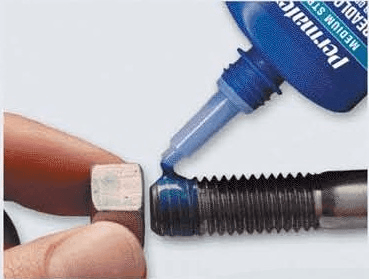
Medium strength (blue) thread locker applied to screw threads. Image credit: Nutty Corp.
Typical thread lockers cure anaerobically and are sold as small containers of fluid, but some manufacturers produce the adhesives as sticks or tapes. Adhesives that use anaerobic curing harden and toughen when isolated from oxygen; this is ideal in thread lockers, since oxygen isolation typically occurs when the compound is sealed between a threaded screw and bolt. Thread locking adhesives are manufactured with a variety of strength and toughness characteristics ranging from easily reversible to semi-permanent when cured, but no thread locking compound is truly permanent, and fasteners secured with even the strongest adhesive can be removed using high heat (> 450° F) and tools.
Color Coding
Thread lockers and retainers are often color-coded to indicate their strength and temperature resistance. The table below describes typical color coding attributes of thread locking products.
|
Strength / Type |
Color |
Break torque |
Turning torque |
Temp. range (°C) |
|
Low |
Purple |
62 in-lb |
27 in-lb |
-54 to 149 |
|
Medium |
Blue |
115 in-lb |
53 in-lb |
** |
|
Medium (surface insensitive) |
Blue |
180 in-lb |
62 in-lb |
** |
|
High |
Red |
230 in-lb |
225 in-lb |
** |
|
High temperature |
Red |
180 in-lb |
270 in-lb |
-54 to 232 |
|
Penetrating |
Green |
90 in-lb |
310 in-lb |
-54 to 149 |
Table credit: Devcon / Wikipedia
Of the above color-coded types, red products should typically be considered permanent and used only on parts that need to be permanently fastened. Blue adhesives provide an excellent grip but can be disassembled using hand tools if needed.
Specifications
For specifications related to thread lockers and other adhesives, including curing and substrate material, please visit Engineering360's Industrial Sealants SpecificationGuide.
References
ReliablePlant - A guide to threadlocking adhesives
Image credit:
Loctite
- Acrylic / Polyacrylate
- Aerospace
- Anaerobic
- Automotive
- Building / Construction
- Ceramic / Glass
- Cyanoacrylate
- Dissimilar Substrates
- Electrical Insulation / Dielectric Material
- Electrical Power / HV
- Electronics
- Epoxy (EP)
- Metal
- Military / Government (MIL-SPEC / GG)
- OEM / Industrial
- Plastic
- Room Temperature Curing
- Rubber / Elastomer
- Single Component System
- Chemical / Polymer System Type: Specialty / Other
- Thermosetting / Crosslinking
- Tooling / Mold Material
- Two Component System
- Water Based / Latex Dispersion