2.3 Partial Fraction Expansion
Generally in the analysis or design of phase-locked loops, the Laplace transform tables of [2] [4] and Appendix A are sufficient if a partial fraction expansion of the transfer function is performed. The concept behind partial fraction expansion is to express the transfer function as a sum of fractions with a simple pole in each denominator. When this is done, the individual terms can use simple transforms such as,
If all of the poles of a transfer function are simple (not repeated), the transfer function can be written as [4]
With partial fraction expansion, Equation 2-29 can be written as
The coefficients for the individual fractions in Equation 2-30 are obtained by multiplying the complete transfer function by the denominator's ( s + ? n) and evaluating the resulting expression at s = ?? n. To demonstrate, [4]
The other numerators of Equation 2-30 are obtained through similar computations. Equation 2-30 is also used to find the coefficients for roots which appear as conjugate pairs. Example 2.1 shows the partial fraction expansion of a transfer function with conjugate pairs.
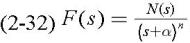
The more difficult partial fraction expansion occurs when the transfer function of Equation 2-29 contains poles that are repeated. As an example, consider
The partial expansion of Equation 2-32 is performed as
Note in Equation 2-33, a single repeated root results in n terms. The numerators are not obtained through the same expression as the simple poles, but a different set...

 TABLE OF CONTENTS