Phase-Locked Loops for Wireless Communications: Digital, Analog and Optical Implementations, Second Edition
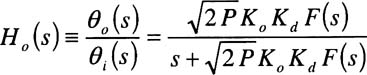
Recall the form of the phase-locked loop's transfer function,
. The order of the PLL is defined as the highest order of s in the denominator of the loop transfer function. For the first order loop, corresponding to Equation 2-50, the highest order of s is one. In the next section, we will study second order loops which have a term s 2 in the numerator. As the phase-locked loop's order is increased, it tends to compensate for an instantaneous change in the next higher derivative of the input [12].
The type of the loop refers to the number of perfect integrators in the loop. A PLL has an implicit perfect integrator with the VCO, so the first order loop is a first order, type 1, loop. A filter, F(s), with a perfect integrator would yield a type 2 loop.
[12]Lewis, P.H., Weingarten, W.E., "A Comparison of Second, Third, and Fourth Order Phase-Locked Loops", IEEE Transactions on Aerospace and Electronic Systems, vol. AES-3, no. 4, pp. 720-727, July 1967.