A Millwrights Guide to Motor/Pump Alignment, Second Edition

This page along with the next several pages are merely an introduction to the concept and theory of Rin and Face Alignment.
While Rim and Face Alignment has been around for a long time, it s still as new and modern in its usefulness as it ever was; in tandem with many more formats in this book than are commonly used.
I read somewhere that in order to teach a person (old or young) about some subject of which the student knows little or nothing, the student has to first be reminded of something that said student already knows. Then, referring to that corner stone of the student s knowledge level, the teacher assembles the remainder of the puzzle piece by piece for the student to view, hear, feel whatever it takes to be certain the student understands before moving on to the next level of subject matter.
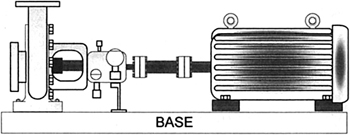
So let s begin with an electric motor; say about 10 horsepower that has to be precision aligned to a specific pump. Both the pump and motor are to be mounted on a base that when finished will look much the same as described in FIGURE 2 .
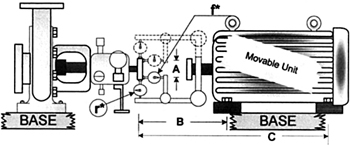
The motor is placed in its approximate finished position about 8" from the pump. FIGURE 1 below shows a viable mounting of dial indicators in the process of procuring readings from the zero setting at 12 o clock (broken lines) to the (solid lines) 6 o clock position.
Some calibrated eyeballing , a scale measure, and...