Sometimes I think it must be the utter simplicity of the wagon wheel principal that makes it so seldom mentioned or used. But if you physically look at a wagon wheel (preferably one with only four spokes, one of which is vertical), it s easy to visualize how one can make some simple calculations and explain to a stubborn bolt-bound motor that it just thinks it has you beaten. Of course we re only discussing a few mils here; not a giant step to a lateral, but for those few mils the controls are in your hands.
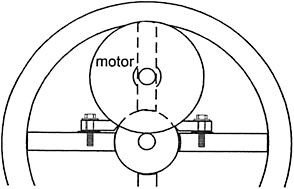
Concentrate on the horizontal spokes and ignore the (broken line) vertical spoke. Assume the motor is bolted to the two horizontal spokes. Now, assume the wagon wheel remains static on its axel, and the motor shaft must be shifted .010" to the left. This is being prevented by a bolt-bound condition. Alright, the hold-down bolts are loosened, .010" of shim material is removed from the left side, then added to the right side, the motor shaft is going to be moved roughly .010" toward the left when everything is bolted back down. This, of course, can be determined exactly; or at least practical (to within four decimal places) when the specific and applicable dimensions are known regarding register points when dimensionally compared each to the applicable other.
Even as this is being written. somewhere there are probably a couple of hundred motors being wagon wheeled to keep from having to cut metal other...
Copyright Tommy B. Harlon 2008 under license agreement with Books24x7


 TABLE OF CONTENTS