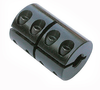
Most journeyman mechanics will already know this, but for the less experienced journeymen and apprentices, those assemblies of (usually metallic and composite) components called couplings are a really quite ingenious and wonderful series of inventions. Typically, couplings will have two identical mating halves that are held in place on the ends of the involved driver and driven shafts with set screws and square keys. See Figure 1 below.
 Figure 1
 The ultra-modern coupling above was first considered ultra-modern sometime between the stone age and the present. It s still practical for use in places where line-shafts transfer and distribute power via pulleys, gear drives, or maybe a crank-throw with which to effect reciprocal motion such as positive displacement piston action for pumping fluids or to compress gaseous mediums such as air. Sown in Figure 1 are the involved shafts, coupling halves, square keys, set-screws, and a rather generic distribution of bearings. The coupling bolts to connect the coupling halves (which could be from only one to almost any practical number) are not shown.
Typically, rotational energy is applied to the drive shaft, through which energy is transferred molecule-at-the-time and into the shearresistant key, set-screw fit, and/or the coupling hub/shaft fit (depending on which combination of said components provide the most efficient metal-to-metal continuity). Then into the coupling bolts or other type of energy transferring medium, then continues into the other coupling half, beyond which exactly reverses the pass-the-buck trip just described. With the power source being point A, and point
Copyright Tommy B. Harlon 2008 under license agreement with Books24x7

 TABLE OF CONTENTS