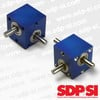
Normally, a gearbox will be a device to receive high speed rotational power at the input end, then transfer said energy through a series of gears that exits said gearbox at many times fewer RPM, but commensurately with many times the input torque capabilities. Some are designed with built-in gear shifting mechanisms that can result in multiple choices of output RPM speeds of the single output power shaft. Somewhere along the chronological time-line, a gearbox with multiple output power shafts was needed where with a single input power source, said energy could be distributed into multiple rotating components. Again, the human brain working in combination with the human hand can produce practically anything that can be imagined. --- --- And then someone discovered that such machines sometimes have to be precision-aligned to multiple power input destinations
A single one-on-one alignment can be difficult at best, but with multiples, spline drives with universal joints are often used. Then come the rare occasions where dial indicator precision on multiple stations on a single gearbox is required. The more power output shafts requiring precision alignment, the more complex the challenge, much of which is largely dependent on the precision with which the target destinations were manufactured. One can ill-afford to assume very much in alignment work, but assume that the two machines were made for each the other with very close tolerances and those tolerances amount to zero. Such fantasy is the subject matter in this chapter. (It s akin to doing battle with...
Copyright Tommy B. Harlon 2008 under license agreement with Books24x7

 TABLE OF CONTENTS