Ordinary Differential Equations in Theory and Practice

Chapter II: Existence, Uniqueness, and Dependence on Parameters

In this chapter we consider and analyse a number of fundamental properties of initial value problems (IVP). In 1 we first show the uniqueness of the solution if a so-called Lipschitz continuity requirement is satisfied. To this end the celebrated Lemma of Gronwall is employed. Then we prove the existence of a solution based on the construction of converging Picard iterates. The convergence is typically a local one. Therefore we show in 3 that we can continue a solution beyond such small intervals and indeed indicate maximum existence intervals. The dependence of a solution on the initial value and the vector field is the subject of the last two sections. In 4 we derive upper bounds for the variations in the solutions if the system is perturbed. These upper bounds are used in 5 to show that continuous perturbations give rise to continuous variations in the solutions. Similarly, we show that perturbations which are differentiable with respect to some parameter result in variations in the solution which are also differentiable with respect to this parameter.

1. Lipschitz Continuity and Uniqueness

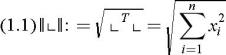
In the following we shall frequently make use of norms. In Appendix B general properties and examples of norms are given. Unless explicitly stated otherwise we shall use the Euclidean norm, defined by


for a vector ?:= ( x 1, , x n) T in .

If the components of ? depend on t ? I, the norm of ? (t) on

UNLIMITED FREE
ACCESS
TO THE WORLD'S BEST IDEAS

SUBMIT
Already a GlobalSpec user? Log in.

This is embarrasing...

An error occurred while processing the form. Please try again in a few minutes.

Customize Your GlobalSpec Experience

Category: Fiber Optic Faraday Rotators
Finish!
Privacy Policy

This is embarrasing...

An error occurred while processing the form. Please try again in a few minutes.