Ordinary Differential Equations in Theory and Practice

3. Rear-Wheel Steering

3. Rear-Wheel Steering

Why is it so difficult to drive a long vehicle backward into a gateway? Why is parking a hard job if the parking space is limited? Is rear-wheel steering favourable when driving around a corner? These questions have one theme in common: what is the relation between the rear-wheel and the front-wheel trajectories of a vehicle? To answer this question, we shall work out a model system. Let us first deal with modelling Steps 1 (Orientation) and 2 (Formulation of relations between variables and parameters).

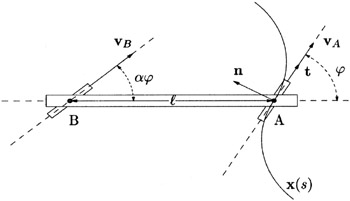
For long vehicles it seems reasonable to assume that the number of front and rear wheels is of only minor importance, and hence we restrict our model to have only one front and one rear wheel. Both are free to turn. The model vehicle is shown in Fig. XII.3. The front and rear wheels touch the ground at the points A and B respectively, and the distance between these points is l. To simulate rear-wheel steering, we assume that the rear wheel turns over an angle ? ?, where ?1< ?<+1, if the front wheel turns over an angle ? to the right or the left. For ?>0 front and rear wheels both steer to the same side, whereas for ?<0 they turn in opposite directions. For ?=0 the vehicle strongly resembles a bicycle.


Figure XII.3: A two-wheel vehicle.

Given the trajectory of the front wheel, the derivation...

UNLIMITED FREE
ACCESS
TO THE WORLD'S BEST IDEAS

SUBMIT
Already a GlobalSpec user? Log in.

This is embarrasing...

An error occurred while processing the form. Please try again in a few minutes.

Customize Your GlobalSpec Experience

Category: Differentials and Axles
Finish!
Privacy Policy

This is embarrasing...

An error occurred while processing the form. Please try again in a few minutes.