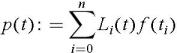
Let a function f(t) be specified at n+1 points t i , i=0, , n. A straightforward way to interpolate f(t) between the known values makes use of polynomials. The Lagrange basis polynomials L i (t) are defined by
One can easily see that they satisfy Li(t i )=1, i=0, , n, and L i (t j )=0 if i ? j. From this it is directly clear that the polynomial
indeed attains the desired values at the grid points t i . The degree of p(t) is n, which is is in general the minimum value for polynomial interpolation at n+1 points. It can be proven that the Lagrange interpolation error can be expressed as
for some ? in the smallest interval containing t 0, t n and t.
If not only function values but also derivatives are prescribed, interpolation can be performed in a similar way, using the Hermite basis polynomials H 1, i and H 2, i . The first one is defined as
The second one is defined as
The basis polynomials H 1, i (t) and H 2, i (t) satisfy the properties H 1, i (t j )= ? i,j,  , H 2, i (t j )=0, and
  ( ? ij=0 if i ? j and ? ii=1). From this we can directly...
Copyright The Society for Industrial and Applied Mathematics 2002 under license agreement with Books24x7


 TABLE OF CONTENTS