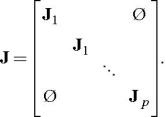
Any n n matrix A can be brought onto Jordan form via a similarity transformation. This implies that a nonsingular matrix S exists such that the matrix J:= S ? 1 AS has the form
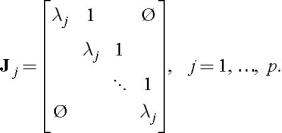
The matrices A and J have the same eigenvalues ? 1, , ? p ( p ? n). Each Jordan block J j is characterised by its size r j and its eigenvalue ? j ( ?  or C). The r j r j Jordan blocks have the form
Different Jordan blocks may have equal eigenvalues and/or size. The number of Jordan blocks with one and the same eigenvalue is called the geometric multiplicity of that eigenvalue. The geometric multiplicity is equal to the number of linearly independent eigenvectors corresponding to that eigenvalue. This can be understood from the fact that a Jordan block of size r j has exactly one eigenvector given by (1, 0, , 0) T with length r j.
The algebraic multiplicity of an eigenvalue is equal to the number of times that the eigenvalue occurs on the main diagonal of J. This multiplicity is thus given by the sum of the dimensions r j of the corresponding Jordan blocks. An eigenvalue of algebraic multiplicity m is an m-fold root of the characteristic polynomial
which has the same roots as the polynomial...
Copyright The Society for Industrial and Applied Mathematics 2002 under license agreement with Books24x7

 TABLE OF CONTENTS