Ordinary Differential Equations in Theory and Practice
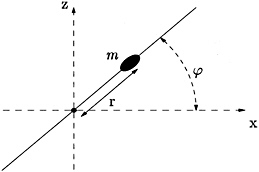
The following mechanical problem may serve as an illustration of many concepts introduced in Chapters IV and XI. The system under consideration is fairly simple, but the differential equations involved are of a very general character and occur in many applications. We consider a long needle that rotates in a vertical plane around its midpoint. Along the needle a bead may move as shown in Fig. XII.6. The construction is such that the bead can freely pass the origin. While the needle rotates, three forces are exerted on the bead: the gravitational force, the frictional force, and, due to the rotation, the centrifugal force. The last force is a so-called pseudo-force. It tends to push the bead from the needle, whereas the gravitational force may be directed both from and to the origin depending on the bead being below or above the origin respectively. The frictional force tends to reduce the bead s velocity. We shall describe the motion of the bead as a function of its initial position and velocity and are especially interested in finding out under what conditions the bead follows a bounded orbit on the needle and does not fly off.
We model this problem using the theory from Chapter XI. In the beadneedle system kinematic constraints are in force. In XI.2 two methods are presented to deal with mechanical systems with kinematic constraints. First we shall apply the method of Lagrange multipliers. Denoting the bead s position by Cartesian coordinates r