Consider the mapping
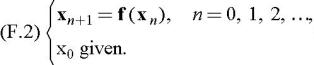
where f maps of some subset of a metric space into itself. A point x which satisfies (F.1) is called a stationary point of the mapping f. A possible method for solving equations of the form (F.1) is to use iteration, i.e. to solve the discrete IVP
The motivation for this method is the following: if the mapping f is continuous and if the sequence { x n} converges, i.e. x n ? x, then
For convergence we need f to be contractive.
Definition F.3 Suppose S is a subset of a metric space X with distance function d. A mapping f : S ? X is called a contraction, with contraction constant L, if
for all x, y ? S, where 0< L<1.
Note that if f is a linear mapping defined on a normed linear space, then f is a contraction if and only if f<1 (see Appendix B). It is also worth pointing out that a contraction may have at most one stationary point. Indeed, if x and y are both stationary points of the contraction f, then
which is a contradiction. The basic theorem on contractive mappings is called the contractive mapping principle (also called the contraction theorem of Banach). This theorem asserts that contractions on complete metric spaces have stationary points. For a proof see [39].
Theorem F.4. Suppose S is...
Copyright The Society for Industrial and Applied Mathematics 2002 under license agreement with Books24x7

 TABLE OF CONTENTS