Ordinary Differential Equations in Theory and Practice

In this section we analyse a daily-life system which is very convenient for illustrating many aspects of chaotic behaviour. Chaotic systems show sensitive dependence on the initial conditions. This sensitivity can generally be switched on and off by adjusting a parameter in the model. This kind of bifurcation is most easily understood for scalar ?-equations, as shown in Chapter VI. A fascinating alternative example, suggested by [70], is the dripping behaviour of a faucet. Experiments show that the dripping pattern varies with the flow rate in a remarkable way. In the experiments the intervals between the falling drops could be measured by laser equipment with a photoelectric sensor.
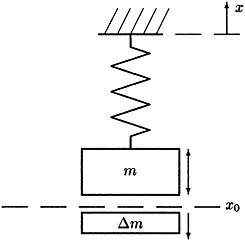
We model the dripping faucet in quite a simple way using only three differential equations. As explained in Chapter VI, this is the minimum number for which chaotic behaviour can occur in continuous time systems. Although the model neglects nearly all physical details of the faucet, it reproduces many of the observed aspects. The dynamics of a drop when still clinging to the faucet is described by a mass-spring system with a gradually increasing mass. At some moment a part of the mass is suddenly separated from the rest. Such a part represents a newly formed drop. In Fig. XII.28 the mass-spring system is depicted. The amount of water attached to the faucet is presented by the time dependent mass m(t). If the faucet is open, m(t) will increase linearly with time: