First, we consider norms of vectors x in a linear vector space V. A norm on V, denoted by , has to satisfy the following four conditions ( x, y ? V, ? ?  (or C)):
-
x ? and x ?0
-
x=0 if and only if x=0
-
? x= ? x
-
x+ y ? x+ y (triangular inequality).
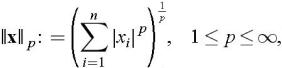
If V=  , the norm is often a so-called H lder norm, defined by
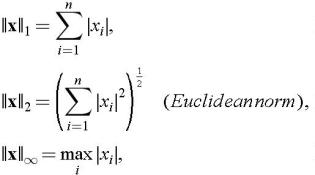
with x i the components of x. For p=1, 2, and ? we have
respectively.
Two norms ? and ? are called equivalent if two constants c 1, c 2 exist, such that for all x ? V
From this we have that a series convergent with respect to one norm is also convergent with respect to an equivalent norm. If V= this implies that convergence considerations are norm independent because any two norms on are equivalent. See, e.g., [39].
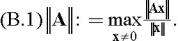
Next matrix norms are considered. Let V be the linear space consisting of matrices. A norm on V satisfies the conditions similar to (i), , (iv). A vector norm induces a matrix norm in a natural way as follows:
Often such a norm is...
Copyright The Society for Industrial and Applied Mathematics 2002 under license agreement with Books24x7

 TABLE OF CONTENTS