Ordinary Differential Equations in Theory and Practice
In 1 we introduce linear multistep methods (LMM) and show some important types. The useful concept of consistency is introduced in 2. Since LMM possess a richer (i.e. higher dimensional) solution space than the problem they discretise, it is important to ensure that the difference equations produce meaningful approximations; in particular one needs so-called root stability, cf. 3. This stability concept and also consistency are shown to be necessary and sufficient for convergence of the numerical solution to the exact one, as is worked out in 4. In 5 we consider the problem of how to obtain enough initial conditions to start the LMM and also give an asymptotically sharp estimate of the global error. For practical purposes it is important to implement implicit LMM jointly with explicit ones; this so-called predictor-corrector technique is dealt with in 6. Finally, in 7 we consider an important aspect of multistep implementation, viz. variable step, variable order algorithms.
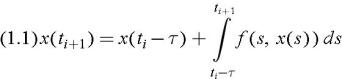
In I.6 we have seen that discretising an ODE can also lead to a multistep method; for example, if the integral in the equation
is approximated by interpolating quadrature, involving more than two grid points t j , j=i+1, i, . If we use e.g. t i +1, t i and t i ?1 and second order equispaced polynomial approximation (i.e. Simpson s rule), we obtain the formula
We may also use a higher order interpolation polynomial on ( t i ?j , t