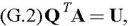
Let A ?  n n be a matrix. Then there exists an orthogonal matrix Q and an upper triangular matrix U, i.e. U=( u ij) with u ij=0, i> j, such that
One can find such a decomposition from the Gram-Schmidt process by viewing the columns of Q as vectors. The columns of Q are successively formed by orthonormalisation, whereas the upper triangular U expresses that the space spanned by the first l columns of A ( l ? n) is the same as the space spanned by the first l orthonormal columns of Q. This decomposition also holds for rectangular matrices. In practice one rather computes Q T (= Q ?1) in
by Householder s method or Givens method, cf. [33]. Here the columns of A below the diagonal are successively sweeped by an orthogonal matrix (much like in Gaussian elimination).
We can fairly easily show now that a symmetric matrix has an orthonormal system of eigenvectors. Indeed, let
be the Jordan form, then write T= QU according to Gram-Schmidt. Hence we find
where V is upper triangular. A is symmetric and so is V; hence V must be a diagonal matrix. The eigenvalues of A are given by the diagonal elements of V, and the eigenvectors are the corresponding columns of Q.
Using this decomposition one can show the...
Copyright The Society for Industrial and Applied Mathematics 2002 under license agreement with Books24x7

 TABLE OF CONTENTS