Ordinary Differential Equations in Theory and Practice
Chapter IV: Linear Systems

In this chapter we consider linear systems in detail. In 1 the global existence and uniqueness of the solutions are shown to follow directly from the general theorems in Chapter II. In 2 and 3 explicit expressions for the solutions are derived. These expressions are studied for the special cases of constant ( 4) and periodic ( 5) systems. The general theory is extensively applied in 6 to planar systems, i.e. systems of order 2. These problems are of great importance in many mathematical models, such as mechanical systems. The classification of planar, autonomous systems is the subject of 7. Finally, in 8 a theory of linear difference equations is given with some emphasis on the apparent similarities between difference and differential equations.

1. Introduction

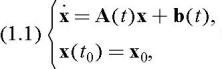
The linear IVP


plays a fundamental r le in the theory of ODE. Because the structure of its solutions is completely understood, the analysis of general, nonlinear ODE is often based on local reductions to linear systems. A typical example of this idea is the technique of linearisation introduced in II.5 and used in the stability theory of V.4. Linearisation is also an essential ingredient in most numerical algorithms to solve ODE.

Throughout this chapter we assume A( t) and b( t) to be continuous functions on . From this we can show that the IVP (1.1) has a unique solution for all t ? . We remark that this does not hold for nonlinear systems in general, as was shown by Example II.1.

UNLIMITED FREE
ACCESS
TO THE WORLD'S BEST IDEAS

SUBMIT
Already a GlobalSpec user? Log in.

This is embarrasing...

An error occurred while processing the form. Please try again in a few minutes.

Customize Your GlobalSpec Experience

Category: Loop Powered Devices
Finish!
Privacy Policy

This is embarrasing...

An error occurred while processing the form. Please try again in a few minutes.