Ordinary Differential Equations in Theory and Practice
Nerves transmit signals through electric pulses, which propagate along the nerves at high speed. This phenomenon has been extensively studied. The physiological processes involved are quite complex, but mainly based on the transport of K + and Na + ions across the nerve membrane. In 1952 a model was published by [47], which highly stimulated the research in this field. The model described a lot of the characteristics of processes of this kind quite well. A special version of the model was proposed by Fitzhugh and Nagumo in 1961. See [55]. The latter is the subject of this section. We shall derive the model equations, analyse some special cases, and outline the results of a full analysis.
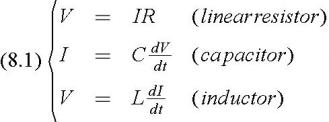
The essential part of the nerve is the membrane. We model this part as an infinitely long, hollow cylinder. The voltage difference V between the outside and the inside of the cylinder is the central quantity in the model. The currents through the membrane are very small, but the resistance is quite high, so that V can still be measured accurately. The potential V depends on time t and position x along the membrane. Because of cylinder symmetry the system is in fact one-dimensional. The electrical properties of the membrane can be described in terms of elementary components: resistor, capacitor, and inductor. The relations between the current I through and the voltage drop V over these components are
with R