Ordinary Differential Equations in Theory and Practice
In this chapter the discretisations which were briefly introduced in the first chapter will be discussed and analysed in more detail. First we consider the construction of one-step methods, in particular Runge-Kutta methods, in 1. Next we investigate the local discretisation error and the consistency (order) of a method in 2. In 3 the notion of convergence (of the numerical approximation to the exact solution) and a theorem, with. sufficient conditions to achieve this, are treated. Since the result of the latter theorem is rather crude, 4 is devoted to giving a more precise estimate of the magnitude of the global discretisation error (viz. by deriving the leading term in the asymptotic expansion). In 5 two methods are given to estimate the in practice more important local error. In 6 this idea is implemented in a practical recommendation for an adaptive integrator. An analysis of the actual errors is also given, for various tolerance criteria, and a number of examples illustrate its effectiveness.
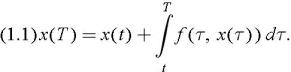
One-step methods are not only mathematically quite natural (as we shall see in Chapter VII on multistep methods); they are also attractive because they do not complicate the computations when the step size is changed. An important class of one-step methods are the Runge-Kutta methods. Consider the equation (cf. (I.6.3))
By taking t= t i and T= t i +1 we may approximate the integral in (1.1) by a quadrature formula, i.e. the discrete sum (cf. Appendix A)
where h:=