Spectrum and Network Measurements

Decibels are used to specify ratios of powers and voltages in a logarithmic fashion. Absolute levels can also be specified via suitable reference values. Decibels are commonly used for gain and loss calculations in electronic systems.
Most, if not all, spectrum and network analyzers display measurement results with their displays calibrated in decibels. The popularity of the decibel in such applications is due to its ability to compress logarithmically widely varying signal levels. For example, a 1 volt signal and a 10 microvolt signal can both be represented on a display with 100 dB of range. To show these two signals simultaneously with reasonable clarity on a linear scale is impossible.
Decibels also are useful for gain and loss calculations, where multiplication operations are transformed into (easier) additions.
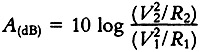
The definition of the decibel (dB) is in terms of a power ratio. Two powers, P 1 and P 2, can be related in dB by the following equation:
| (2-1) | |
where log indicates the base 10 logarithm.
As shown, P 2 is expressed relative to P 1. Reversing P 1 and P 2 changes the sign of the result in decibels.
If the powers P 1and P 2 resulted from a pair of voltages across a pair of resistors then
| (2-2) | |
| (2-3) | |
| (2-4) | |
The first term is the voltage form of the decibel equation, and the second term accounts for differences in the two resistances. If the two...