Spectrum and Network Measurements

Chapter 9: Pulse Measurements

Pulsed waveforms are an important class of signals in such systems as radar and digital radio. Pulsed signals can present a more difficult measurement problem than continuous waveforms. With a small-resolution bandwidth, the displayed spectrum has discrete spectral lines. With wide-resolution bandwidths, these line spectra are smeared together and the spectrum appears to be continuous. Under such measurement conditions, the settings of the spectrum analyzer greatly affect the measured results.

The principles associated with the pulsed waveform (or pulse train) are also applicable to pulsed radio frequency signals. The envelope of the spectrum is the same and depends on the pulse width, but the spectrum is centered on the RF carrier frequency.

9.1 Spectrum of a Pulsed Waveform

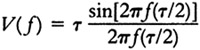
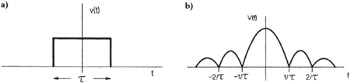
As shown in Chapter 3, the Fourier transform of a single pulse has a (sin x)/ x shape (Figure 9-1):

(9-1)

Figure 9-1: (a) A pulse in the time domain. (b) The corresponding spectrum in the frequency domain.

The nulls of the spectrum occur at multiples of 1/ ?. The amplitude of the spectrum is proportional to the pulse width. This makes sense in that the wider the pulse, the more energy present in it.

A swept spectrum analyzer is not capable of measuring a transient event such as a single pulse. However, an FFT spectrum analyzer can produce the spectrum of such a signal as long as it is within the bandwidth of the analyzer.

A pulse train is produced by repeating the pulse periodically (Figure 9-2a). Since...

UNLIMITED FREE
ACCESS
TO THE WORLD'S BEST IDEAS

SUBMIT
Already a GlobalSpec user? Log in.

This is embarrasing...

An error occurred while processing the form. Please try again in a few minutes.

Customize Your GlobalSpec Experience

Category: Spectrum Analyzers and Signal Analyzers
Finish!
Privacy Policy

This is embarrasing...

An error occurred while processing the form. Please try again in a few minutes.